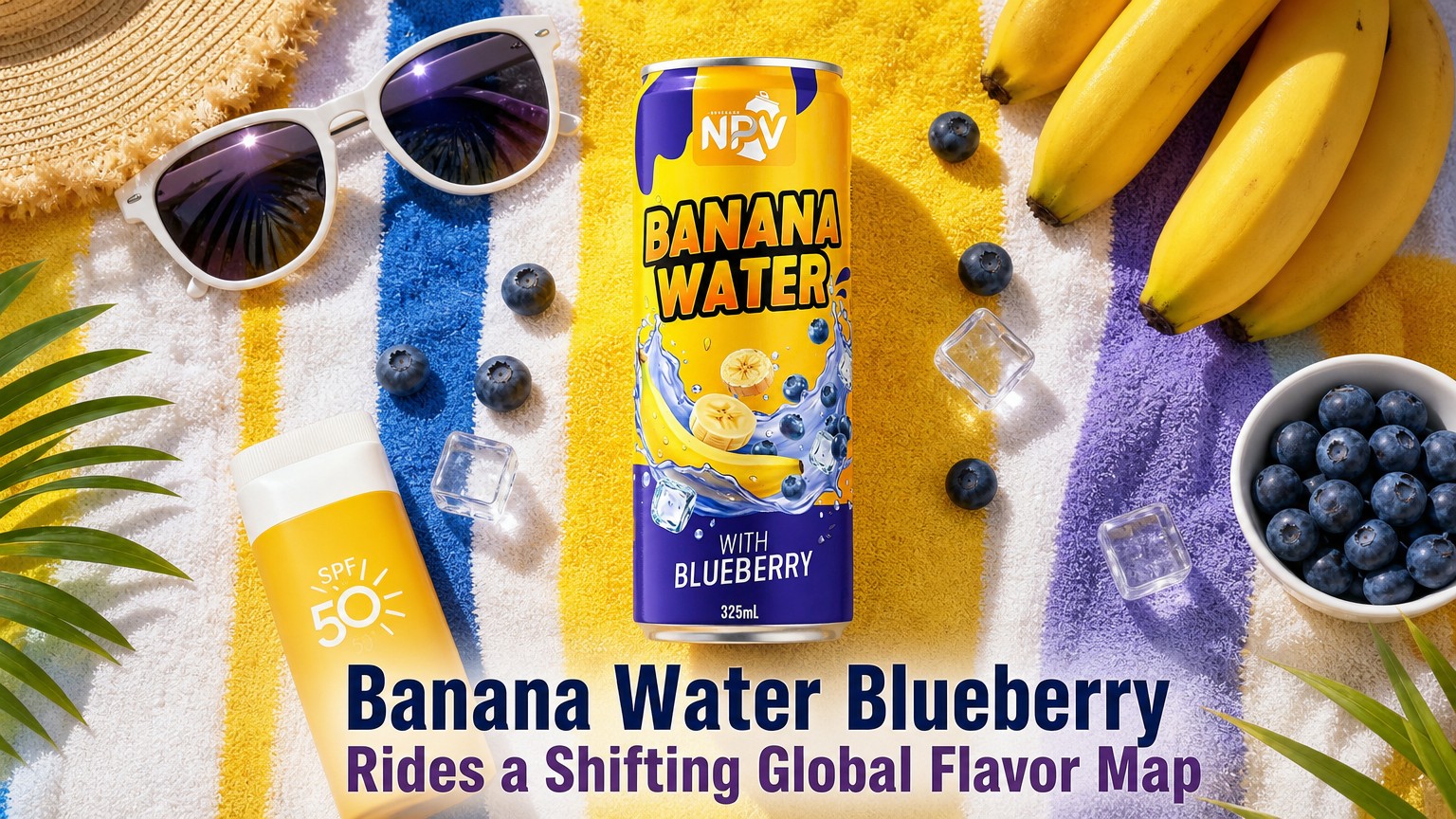
Textured fruit drinks are moving from regional curiosity to mainstream export shelf presence, and buyers across Asia, Europe, the Americas, the Middle East, Africa and Oceania are scanning for cans that travel well and read as familiar at first glance. NPV Banana Water Blueberry answers that brief by pairing sweet banana extract with tangy blueberry notes and chewy nata de coco pieces inside a 325ml aluminum can, a format built for long-haul container logistics and private label rollout.
Key Takeaways
- NPV Banana Water Blueberry combines banana extract, blueberry extract and nata de coco in a 325ml can positioned for international distribution.
- Approximately 58 calories per serving and a 24-month ambient shelf life give importers a stable SKU profile for wide geographic reach.
- Certification coverage including BRC, FSSC 22000, Halal Jakim, Halal HCA-GCC, Kosher, ISO, GMP, HACCP and SMETA supports entry into regulated markets.
- OEM, ODM and private label programs let distributors adapt formulation, artwork and case configuration to regional preferences.
- Banana sourcing draws on documented field-to-factory growing programs in Vietnam’s fruit belt.
Why Banana Blueberry Appeals Across Markets
Export beverage categories rarely succeed on novelty alone; they succeed when a flavor decodes instantly and still rewards the second sip.
That is the commercial logic behind the banana water blueberry combination. Banana is among the most universally recognized fruit flavors in the global soft drink aisle, appearing in formulations from Southeast Asian still drinks to European dairy-adjacent beverages. Blueberry, by contrast, carries a premium cue in many Western retail environments and an increasingly mainstream position in urban channels across the Middle East and Africa. Together they form a two-note profile that a shopper can read from a distance on a can front panel.

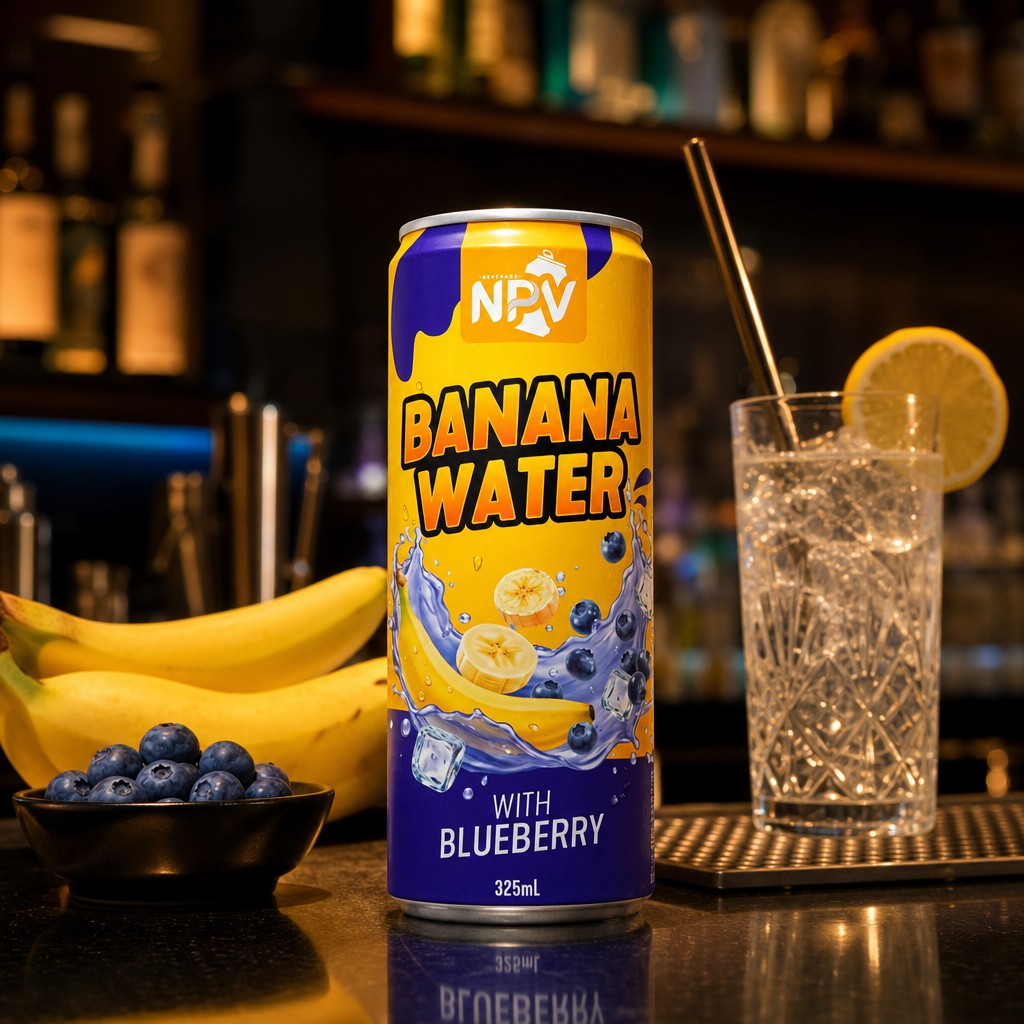
What separates this offering from a standard still juice is the suspended nata de coco. Chewable particles have migrated from bubble tea and aloe vera cups into cans and PET formats, and category watchers point to them as one of the few differentiation levers still available once sugar reduction and flavor extension have been exhausted. A drink that offers both a flavor story and a texture moment gives a retailer a reason to allocate facings.
The 325ml can also aligns with current preference data. Single-serve aluminum packages continue to take share from larger formats in convenience-led channels, and the material’s recyclability profile shows up routinely in European and North American tender documents. For importers, an aluminum can holding 24 months of ambient stability simplifies warehouse planning compared with chilled or short-dated alternatives.
Texture as a Commercial Differentiator
Buyers evaluating a new SKU tend to ask three questions: does it taste approachable, does it look distinctive on shelf, and does it deliver an experience that a carton of plain juice cannot replicate. Nata de coco answers the third question directly.
- Chewable inclusions create a longer consumption occasion than a plain still drink.
- Suspended particles are visually legible and frequently referenced on can artwork.
- The format already carries consumer familiarity across Asian, Middle Eastern and African markets through aloe vera and coconut-based drinks.
- Sweetness and acidity can be tuned per territory without changing the core concept.
For a private label program, that flexibility matters. A distributor launching the same base concept in different territories can vary sugar level and fruit ratio while keeping a consistent visual identity across the range.
Product Profile of NPV Banana Water Blueberry
Spec-sheet detail is what converts interest into a purchase order, so the numbers behind the can deserve a clear look.

Formulation and Ingredient Choices
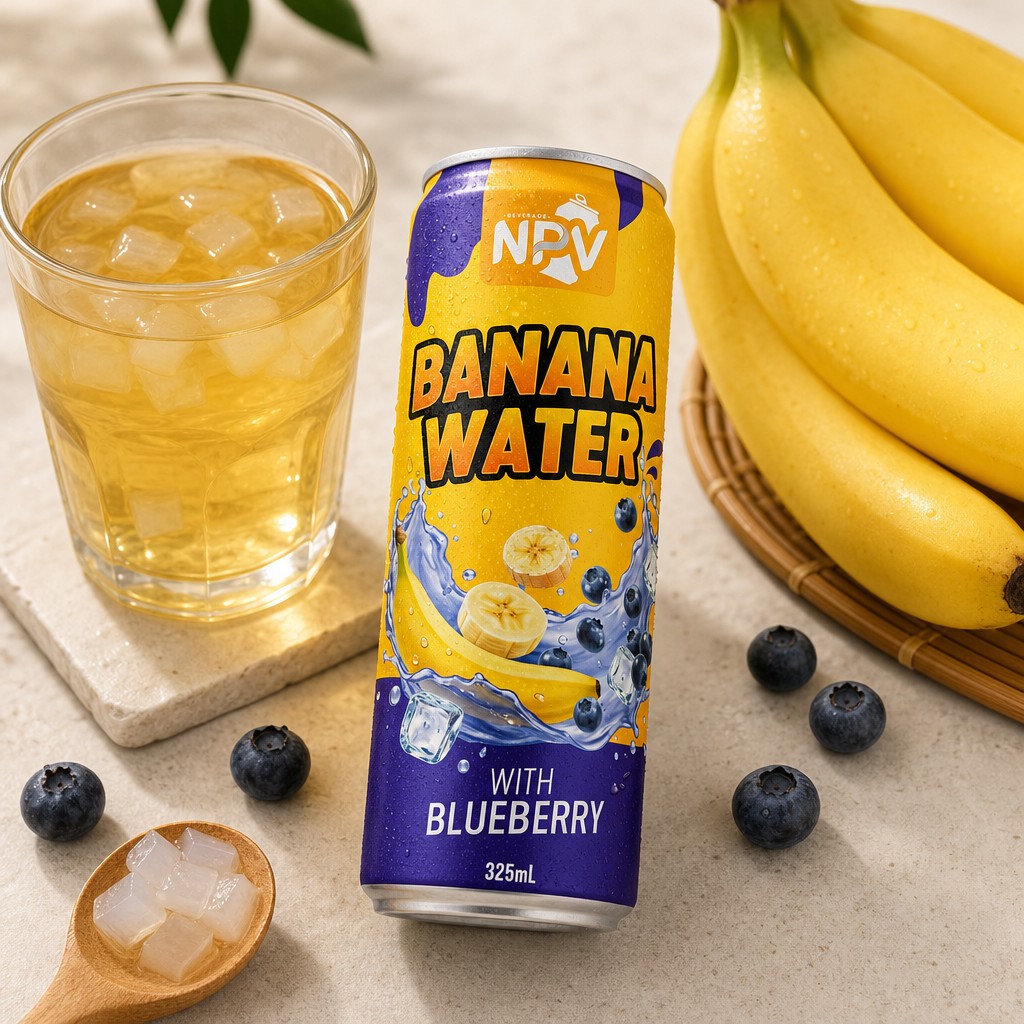
The ingredient panel is deliberately short: water, banana extract, blueberry extract, nata de coco, sugar, citric acid, stabilizers and sweeteners. Every component has a defined function, and nothing in the list demands refrigerated distribution, which keeps landed cost predictable for importers operating in warmer climates.
Caloric density sits at roughly 58 calories per serving, placing the drink in the everyday refreshment band rather than the indulgent treat category. That positioning supports repeat purchase behaviour in convenience, grocery and travel-retail channels where the can competes against both carbonated soft drinks and plain bottled water.
| Specification | Detail |
|---|---|
| Product name | NPV Banana Water Blueberry |
| Volume | 325ml |
| Packaging | Aluminum can with yellow and purple artwork |
| Key ingredients | Water, banana extract, blueberry extract, nata de coco, sugar, citric acid, stabilizers, sweeteners |
| Calories per serving | Approximately 58 |
| Shelf life | 24 months at ambient temperature |
| Program type | OEM, ODM and private label |
| Export reach | 200+ countries and territories |
Source: NPV Beverage product documentation.
Packaging Engineered for Long-Haul Shipping
Yellow and purple graphics do more than look energetic; they create shelf contrast against the green and white blocks that dominate adjacent juice bays. Banana and blueberry illustrations on the front panel communicate the flavour story without multilingual copy, which lowers artwork revision costs for multi-market launches.
From a logistics standpoint, the aluminum can is nestable, pallet-efficient and resistant to the humidity swings common in transshipment hubs. That combination is a practical advantage for distributors consolidating several SKUs into shared containers from a single Vietnamese loading port.
From Vietnamese Growing Areas to the Export Container
Raw material provenance is becoming a line item in importer due diligence, not a marketing afterthought.
Banana supply for this category draws on Vietnam’s established fruit-growing regions, where field-to-factory programs have been documented in unusual detail. One widely referenced account traces the banana journey from plantation to processing facility, showing how fruit is graded, transported and handled before it enters a beverage line. Sourcing teams often review that record alongside their own supplier audits.
Structured growing relationships matter commercially as well as procedurally. Predictable harvest windows, agreed quality thresholds and repeatable ripeness standards reduce formulation drift between production runs, which protects the taste consistency an importer depends on when reordering a fast-moving SKU.
Field documentation video: https://www.youtube.com/watch?v=xIgzs1NXNiA
Blueberry extract enters the formulation through refined sourcing rather than fresh fruit intake, a standard practice in the flavored beverage sector. The result is a consistent colour and aroma profile that does not fluctuate with seasonal crop variation, an attribute that quality teams value when signing off on annual supply contracts.
Certification Coverage That Supports Cross-Border Trade
A beverage cannot travel further than its paperwork allows.
NPV Beverage holds a certification stack spanning the compliance regimes most frequently encountered in international tenders: BRC, FSSC 22000, Halal Jakim, Halal HCA-GCC, Kosher, ISO, GMP, HACCP and SMETA. For a buyer in the Gulf region, Halal HCA-GCC coverage removes a procurement hurdle before commercial negotiation even begins. For a European retailer, BRC and FSSC 22000 documentation is often a prerequisite for listing discussions. For a North American importer, HACCP and GMP records underpin the supplier questionnaire process that gates first orders.
Why Dual Halal Accreditation Matters
Holding both Jakim and HCA-GCC approvals is a detail experienced importers notice immediately. It signals that the manufacturer has pursued accreditation across two distinct certification ecosystems rather than relying on a single scheme, which shortens the paperwork trail when one production line serves multiple destinations.
- BRC and FSSC 22000 for retail and manufacturing audits in Europe and Oceania.
- Halal Jakim and Halal HCA-GCC for Southeast Asian and Gulf markets.
- Kosher certification for specialty distribution channels in the Americas.
- ISO, GMP and HACCP as baseline quality management evidence.
- SMETA for the ethical audit requirements imposed by certain European buyers.
Combined with an export footprint reported at more than 200 countries and territories, this compliance profile gives distributors a head start when opening new territories. The full product page for NPV Banana Water Blueberry carries the specification detail procurement teams typically request at first contact.
OEM and Private Label Pathways for Buyers
Most inquiries for this SKU arrive from distributors who do not want a finished branded can; they want a base platform they can own.

Nguyen Pham Viet Beverage Co., Ltd., established in 2019, operates as a Vietnamese B2B manufacturer and exporter with in-house research and development, production and global trading capability. RITA’s OEM beverage service illustrates the kind of formulation-to-export support regional buyers have come to expect, including artwork adaptation, sweetness tuning and case configuration for container planning.
The banana water base extends naturally into a wider fruit family. The manufacturer’s fruit juice range includes papaya, orange, mango and soursop variants, allowing a buyer to build a coordinated tropical block on one shelf rather than listing a single isolated item.
What Buyers Ask Before Listing NPV Banana Water Blueberry
Portfolio logic deserves a pause here. Retailers increasingly evaluate suppliers on range depth rather than single-SKU merit, because a supplier able to deliver four or five complementary cans under one private label identity simplifies negotiations, reduces freight paperwork and improves promotional planning across the season.
For buyers ready to evaluate the specific item, the NPV Banana Water Blueberry product listing provides packaging artwork, ingredient detail and program options in one place, and sampling requests can be raised through the same channel.
Trade Signals Worth Watching This Cycle
Macro movement in the beverage sector continues to reward companies with flexible manufacturing bases and broad distribution reach.
Recent developments underline how quickly portfolio priorities shift. PepsiCo’s revised expectations around its functional soda acquisition suggest investors are recalibrating what premium positioning is worth once growth normalizes. Nestle’s decision to earmark additional funds for its Mexican operations points the other way, with multinational capacity investment still concentrating in established production geographies.
Partnership activity remains lively. Kirin’s collaboration with HiteJinro on South Korean beer production shows that licensing and co-manufacturing arrangements remain a practical route into markets where local knowledge carries a premium. Meanwhile LVMH’s wine and spirits segment continues to post sales growth, a reminder that premiumization has not stalled even as mainstream categories normalize. A profit warning at Finland’s Olvi offers a counterweight, showing that mid-sized players exposed to narrower portfolios stay sensitive to cost and demand swings.
Against that backdrop, the NPV Banana Water Blueberry occupies a defensible position: a documented, certified platform that lets buyers add a distinctive yet readable SKU to an existing tropical beverage block without multi-year development work.
Frequently Asked Questions
What flavours and textures does NPV Banana Water Blueberry deliver?
Sweet banana extract meets tangy blueberry notes, with chewy nata de coco pieces suspended in the liquid. The 325ml aluminum can presents the combination in a single-serve format suited to convenience, grocery and travel retail channels.
What certifications support export of the product?
The manufacturer holds BRC, FSSC 22000, Halal Jakim, Halal HCA-GCC, Kosher, ISO, GMP, HACCP and SMETA, covering the compliance requirements most often requested by retail and foodservice buyers in Europe, the Americas, the Middle East, Asia, Africa and Oceania.
Can the formula, sweetness level and artwork be adjusted under private label?
Yes. OEM, ODM and private label programs allow buyers to modify sugar level, acidity balance, fruit ratio and can artwork while retaining the core banana-blueberry concept and nata de coco texture.
What is the shelf life and how should the product be stored?
The drink carries a 24-month shelf life at ambient temperature, which simplifies warehousing and container planning for importers operating across long transit routes.