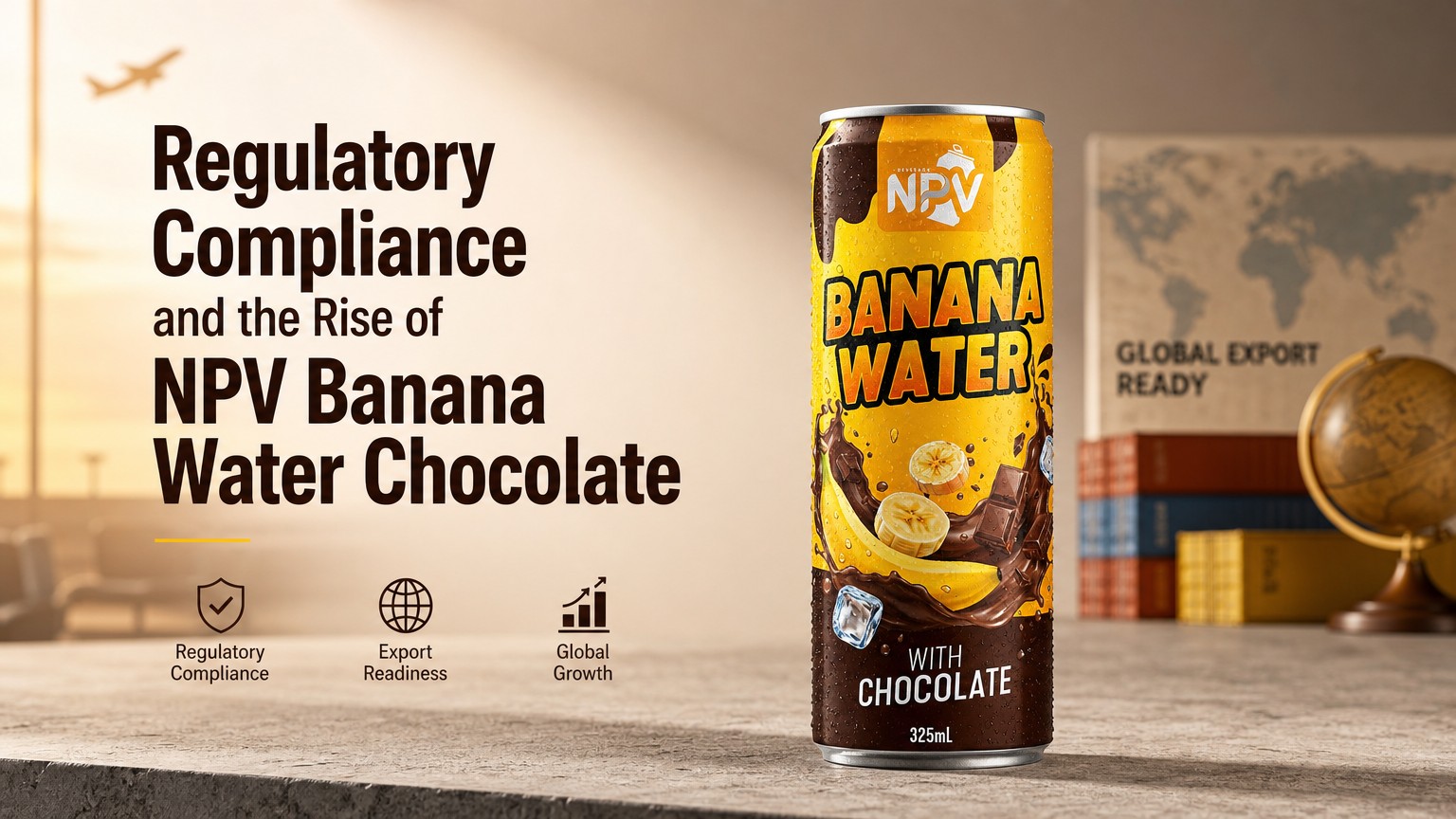
The global ready-to-drink beverage trade is being reshaped by regulation as much as by flavour. Importers across Asia, Europe, the Americas, the Middle East, Africa and Oceania now review certificates, labelling wording and shelf-life statements before a single pallet clears customs. Within that climate, NPV Banana Water Chocolate, a 325mL canned dessert-style drink from NPV Beverage, offers a clear example of how a familiar flavour pairing is positioned for cross-border distribution when compliance is built into the product brief from the very first formulation meeting.
Key Takeaways
- Regulatory readiness, rather than flavour novelty alone, increasingly decides how fast a ready-to-drink beverage export moves through buyer approval.
- NPV Banana Water Chocolate is manufactured under BRC, FSSC 22000, ISO, GMP, HACCP, Halal and Kosher frameworks that match common importer checklists.
- A 24-month shelf life inside a recyclable aluminium can supports long-haul shipping and multi-channel placement.
- OEM and private label flexibility lets buyers adjust sweetness, formulation and packaging to fit local rules.
- At roughly 59 kcal per 325mL can, the drink is a lightweight single-serve option for convenience, vending and travel retail.
Regulatory Landscape for Ready-to-Drink Beverages Worldwide
Compliance calendars now sit alongside product development calendars for any exporter planning to ship ready-to-drink beverages worldwide.
Each destination applies its own layer of requirements: microbiological limits, permitted additives, nutrition declaration, date marking and sometimes religious certification. A chocolate-flavoured milk drink may be classed as a dairy product in one jurisdiction and as a flavoured beverage in another, and that single classification can change everything from process records to front-of-pack wording. The more of these variables a manufacturer resolves before production begins, the shorter the buyer approval cycle tends to be.
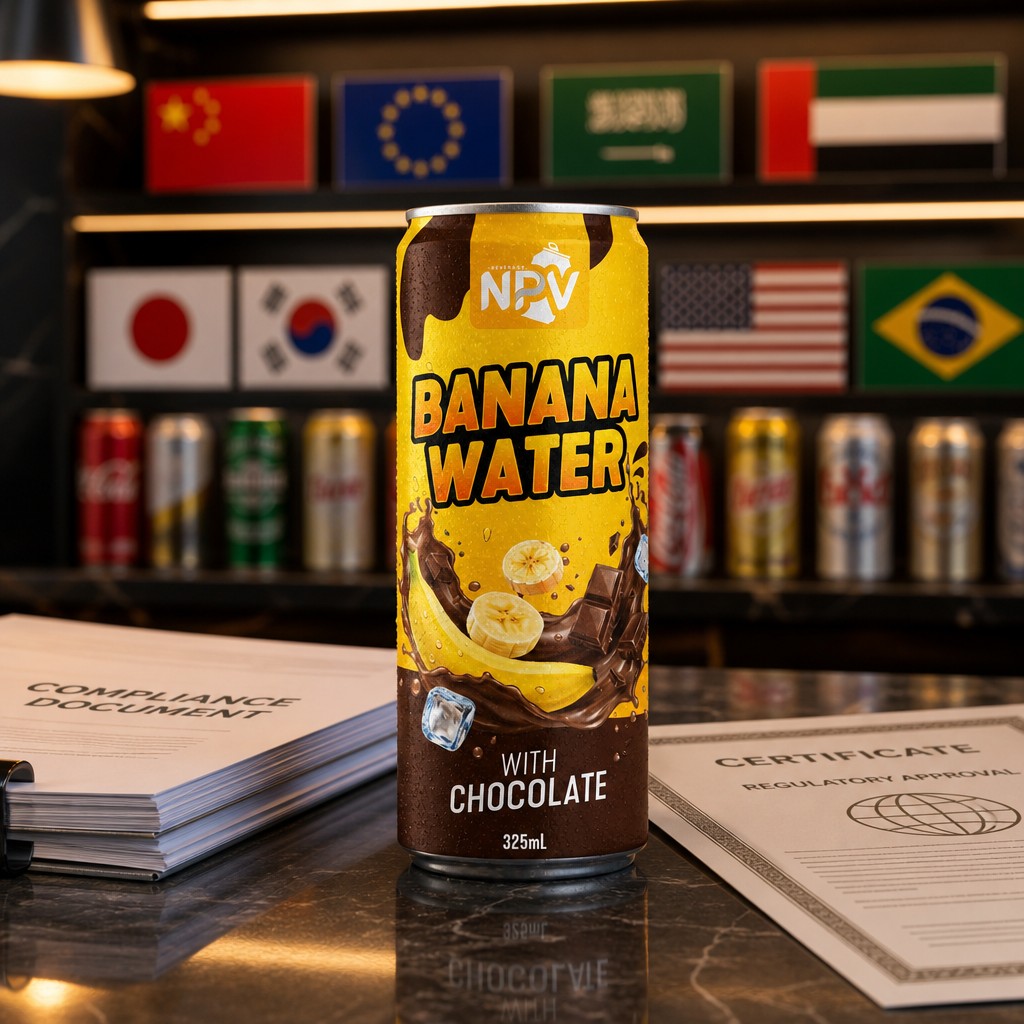
For NPV Beverage, established in 2019 as a Vietnam beverage manufacturer and exporter specialising in OEM and ODM services, that sequencing is standard practice. The company now ships to more than 200 countries and territories, which means documentation packages have to satisfy very different regulatory cultures at the same time and under the same quality system.
Market watchers describe a straightforward pattern. Audited food safety systems get reviewed first, flavour gets reviewed second.
Certifications Behind NPV Banana Water Chocolate
Certificates are the paperwork version of a product’s credibility, and for a dessert-style drink they carry most of the early due diligence.
Food Safety Credentials and Audit Expectations
NPV Beverage holds BRC, FSSC 22000, ISO, GMP and HACCP credentials, alongside SMETA for ethical auditing. In practice this means process controls, traceability records and hygiene management are documented to internationally recognised standards rather than asserted at the point of sale. NPV Banana Water Chocolate is produced within that framework, so a technical questionnaire from a prospective buyer can be answered with a food safety certification file instead of a set of assurances.
Grocery chains and importers routinely ask for a GFSI-recognised scheme during supplier approval, and FSSC 22000 satisfies that requirement across most major retail groups. SMETA adds a social compliance dimension that European and North American buyers increasingly fold into the same review, meaning one audit cycle can clear several gates at once.
Halal and Kosher Certification for Restricted Markets
Religious certification opens doors that food safety paperwork alone cannot. NPV Beverage carries Halal Jakim and Halal HCA-GCC approvals plus Kosher certification, covering demand from the Middle East, ASEAN and specialty retail programmes.
The Halal HCA-GCC credential is particularly relevant for Gulf distribution, where importers commonly require a certification recognised across the GCC states. Kosher status supports listings with specialty retailers and private label programmes that ask suppliers to hold a broader compliance envelope than the minimum local rule.
| Standard | What it covers | Where buyers commonly request it |
|---|---|---|
| BRC | Global food safety benchmark for manufacturers | UK and European retail audits |
| FSSC 22000 | GFSI-recognised food safety management system | International grocery chains |
| ISO and HACCP | Quality management and hazard control | General import due diligence |
| Halal Jakim / HCA-GCC | Permissibility certification for Muslim consumers | Middle East and ASEAN distribution |
| Kosher | Dietary compliance certification | Specialty retail and private label programmes |
| SMETA | Ethical audit of labour and social conditions | Multi-site supplier approvals |
Certification scope summarised from publicly available standard descriptions.
From Field to Can, Sourcing and Traceability
Traceability is the operational backbone behind every certificate an auditor reviews.
The banana note in the drink’s flavour profile connects to documented sourcing work: an account of the banana field-to-factory journey follows the fruit from cultivation through to processing, which is exactly the kind of record trail that supports raw material verification during an audit.
Cocoa powder drawing on a wider agricultural base rounds out the recipe, and the Mekong Delta raw ingredient area is documented as a high-quality sourcing zone for Vietnamese agricultural inputs, including cacao cultivation across the southern provinces.
Video walkthrough of the sourcing route: https://www.youtube.com/watch?v=xIgzs1NXNiA
Buyers evaluating a supplier often ask where inputs come from before they ask how the drink tastes. Consistent sourcing documentation shortens that conversation considerably.
Formulation and Labelling Flexibility for Private Label Buyers
For importers building their own range, the ability to adjust a formula without rebuilding a supply chain matters more than any single flavour.
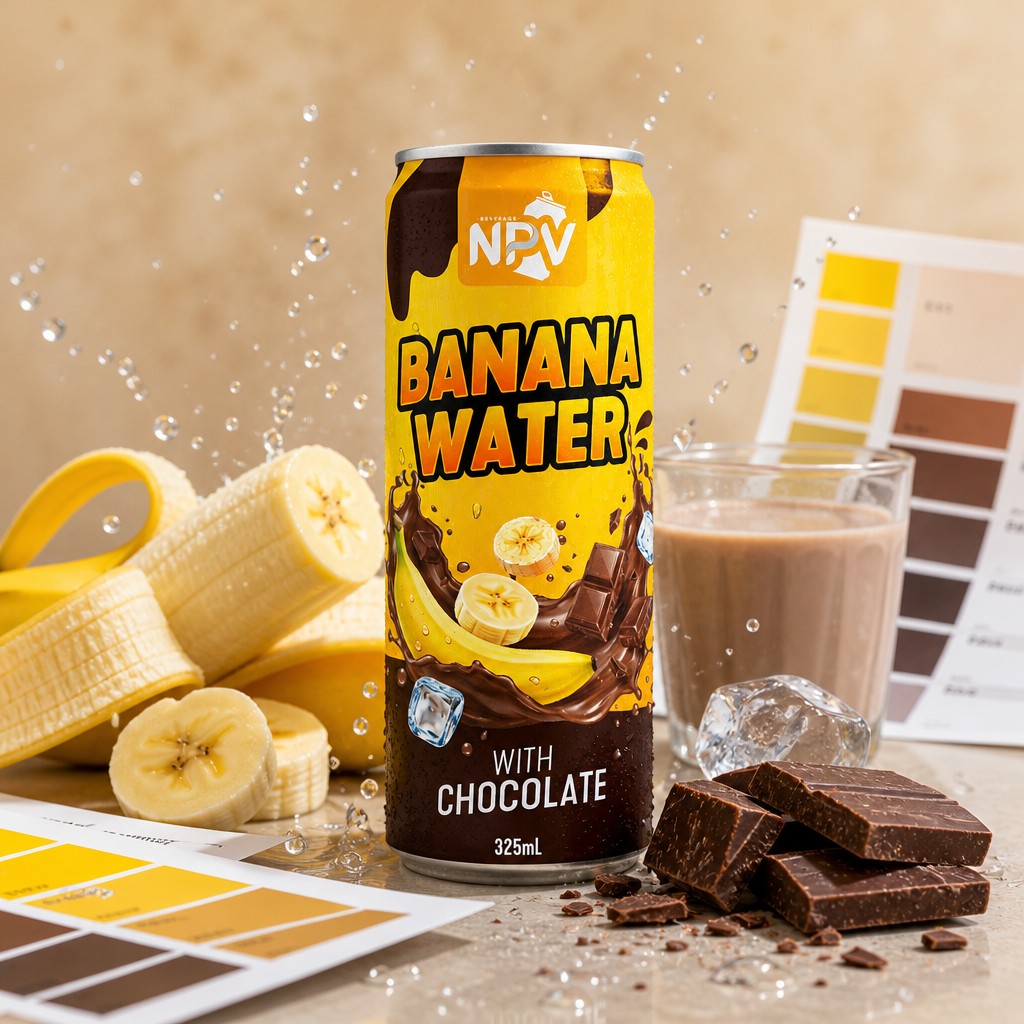
The base formulation of NPV Banana Water Chocolate combines water, whole milk powder, milk protein concentrate, sodium caseinate, banana water extract, alkalised cocoa powder and chocolate flavouring, producing a smooth, creamy texture with a rounded cocoa finish. Because the profile is built from a short and recognisable ingredient list, buyers can discuss modifications against a clear starting point rather than an opaque recipe, and this banana chocolate canned drink stays easy to declare on any label format.
Sweetness levels, cocoa intensity and pack formats can all be revisited under OEM arrangements, and the product sits naturally alongside NPV’s milk drinks lineup for retailers looking to build a coherent shelf story across dairy-adjacent formats.
Adjusting Sweetness and Copy for Local Rules
Different markets set different thresholds for sugar declaration and front-of-pack warnings, so formula tuning is frequently a compliance task rather than a taste preference. RITA’s OEM manufacturing service illustrates how Vietnamese producers handle these requests at scale, with formulation, sweetness and packaging adjusted to buyer specification while documentation is updated in step.
RITA, which operates alongside NPV in the same export ecosystem, has built its reputation on private label beverage programmes delivered to importers across many markets. The parallel structure gives buyers a useful second reference point when they compare manufacturing partners, and it reinforces a simple industry truth: flexible production is a service line, not an exception request.
What NPV Banana Water Chocolate Communicates on Label
Ingredient lists, allergen statements drawn from milk protein, nutrition figures and date marking all have to survive translation into the destination market’s prescribed format. At approximately 59 kcal per can, the nutrition panel is simple enough to present clearly even where strict per-100mL conversion rules apply. Detailed ingredient declaration and clear date coding remain the two items that most frequently delay a shipment, so both are treated as fixed requirements during artwork approval rather than left until after production.
Packaging, Shelf Life and Retail Channel Readiness
The can itself is part of the compliance conversation, from material declaration to shelf-life claim.
Each 325mL unit ships in a standard aluminium can with a playful design that runs from banana-yellow at the top to chocolate-brown at the bottom, communicating the flavour profile at a glance while keeping artwork consistent across print runs. Aluminium is widely accepted as recyclable packaging, which helps satisfy the packaging recovery expectations now written into several European procurement policies and retailer scorecards.
A beverage shelf life of 24 months gives importers room to plan sea freight, warehousing and promotional calendars without compressed sell-through pressure. That duration also keeps the product viable where operators manage distant inventory and prefer long-life canned formats over short-dated chilled lines.
The NPV Banana Water Chocolate canned drink is positioned for the channels where single-serve convenience and predictable shelf life carry the most weight:
- Convenience stores and supermarkets seeking an indulgent yet lightweight option
- Vending machines where long-life canned products reduce service frequency
- Travel retail and transit hubs with limited cold-chain availability
- Cafes and dessert counters adding a quick chocolate-banana pairing
- Wholesale importers consolidating mixed pallets for multi-market delivery
Channel fit matters because each of those environments applies its own packaging, date marking and display requirements. Preparing one documentation set that satisfies all five keeps the approval process moving instead of restarting it for every account.
For buyers who want to widen the range beyond a single dessert format, the wider NPV soft drinks range provides complementary canned options that share the same certification base and logistics profile.
Frequently Asked Questions
What certifications does NPV Banana Water Chocolate hold?
The product is manufactured by NPV Beverage under BRC, FSSC 22000, ISO, GMP and HACCP systems, with Halal Jakim, Halal HCA-GCC and Kosher certifications, plus SMETA for ethical auditing. Together these cover the documentation that most importers request during supplier qualification.
What is the pack format and shelf life of the drink?
It is a 325mL aluminium can with a 24-month shelf life, designed for long-haul shipping, warehouse storage and single-serve retail across convenience, vending and travel retail channels.
Can the formulation or label be adjusted for private label buyers?
Yes. NPV Beverage supports OEM and private label arrangements, allowing adjustments to sweetness, cocoa intensity, formulation, pack format and packaging artwork to meet local market and labelling rules, with documentation updated alongside each revision.
Which markets can the product be exported to?
NPV Beverage exports to more than 200 countries and territories across Asia, Europe, the Americas, the Middle East, Africa and Oceania, with a certification set that addresses food safety, religious compliance and social audit expectations in those destinations.