As beverage buyers around the world weigh packaging choices, shelf life and formulation flexibility, the NPV Matcha Chocolate Original has entered the ready-to-drink conversation as a compact 325ml can that pairs the vegetal character of matcha green tea with smooth cocoa in a milk-based format. Produced by NPV Beverage, a Vietnamese B2B manufacturer focused on OEM, ODM and private label programs, the drink reflects a wider shift in the industry, where sustainability has moved from a marketing line to a specification that shapes ingredients, packaging, logistics and shelf strategy. This article examines how the product is positioned, what it signals about export-oriented beverage manufacturing, and where the commercial opportunities sit for distributors and retail brands.
Key Takeaways
- NPV Matcha Chocolate Original is a 325ml ready-to-drink milk beverage combining matcha powder and alkalised cocoa powder in a single can.
- At 64 calories per can with a 24-month ambient shelf life, the format reduces dependence on cold-chain logistics.
- The aluminum can body supports the recyclability requirements increasingly written into retail tenders.
- Production runs under BRC, FSSC 22000, Halal, Kosher, ISO, GMP and HACCP standards, supporting export to 200+ countries and territories.
- OEM and ODM programs let partners adjust formulation, artwork and case configuration for local shelf requirements.
Sustainability Moves to the Center of Global Beverage Strategy
Sustainability has become a procurement criterion rather than a communications exercise, and buyers now ask about it long before the first sample ships.
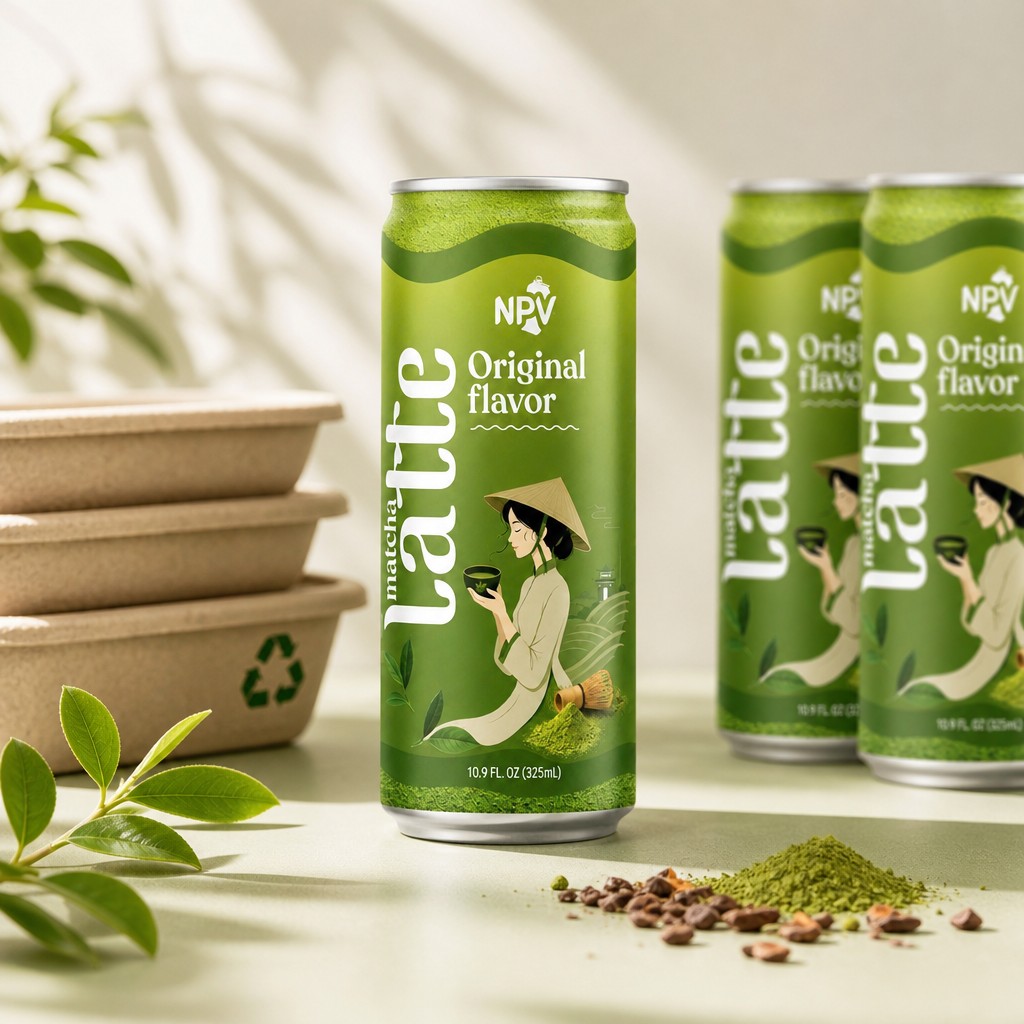
Across Asia, Europe, the Americas, the Middle East, Africa and Oceania, retail tenders and import contracts increasingly reference packaging recyclability, transport efficiency and audit documentation. Sustainable beverage packaging is now a scored line item in supplier qualification, and for a ready-to-drink can the aluminum format benefits from established collection and reprocessing streams in most mature markets. That makes the container a defensible answer when a distributor is questioned during a tender review, without requiring any change to the recipe inside.
The Logistics Case for Ambient Distribution
The 24-month ambient shelf life is the quiet engine behind the product’s sustainability case.
Because the drink is formulated and heat-processed to remain stable at room temperature, importers can book standard sea freight instead of reefer space, and retailers can hold inventory without allocating chilled cabinet capacity. Fewer refrigerated kilometres, fewer energy-intensive storage nodes and simpler last-mile handling all feed into the carbon accounting that procurement teams increasingly track. It is a quiet form of sustainability, measured in logistics rather than printed on a label.
A lighter can also carries less freight weight per unit than a glass bottle of the same volume, and the 325ml body stacks efficiently in cartons and pallets, improving cube utilisation inside shipping containers. For a distributor comparing landed cost per unit, packaging geometry matters as much as the recipe, and aluminium’s strength-to-weight ratio keeps breakage rates near zero across long ocean transit. There is a further design detail worth noting: the artwork is printed directly onto the can body, so no external label or adhesive is required, and the graphics travel with the metal into the recycling stream rather than separating as a plastic sleeve.
Inside the NPV Matcha Chocolate Original 325ml Can
One can carries two flavors and a deliberately restrained calorie count, which is uncommon in the ready-to-drink milk aisle.
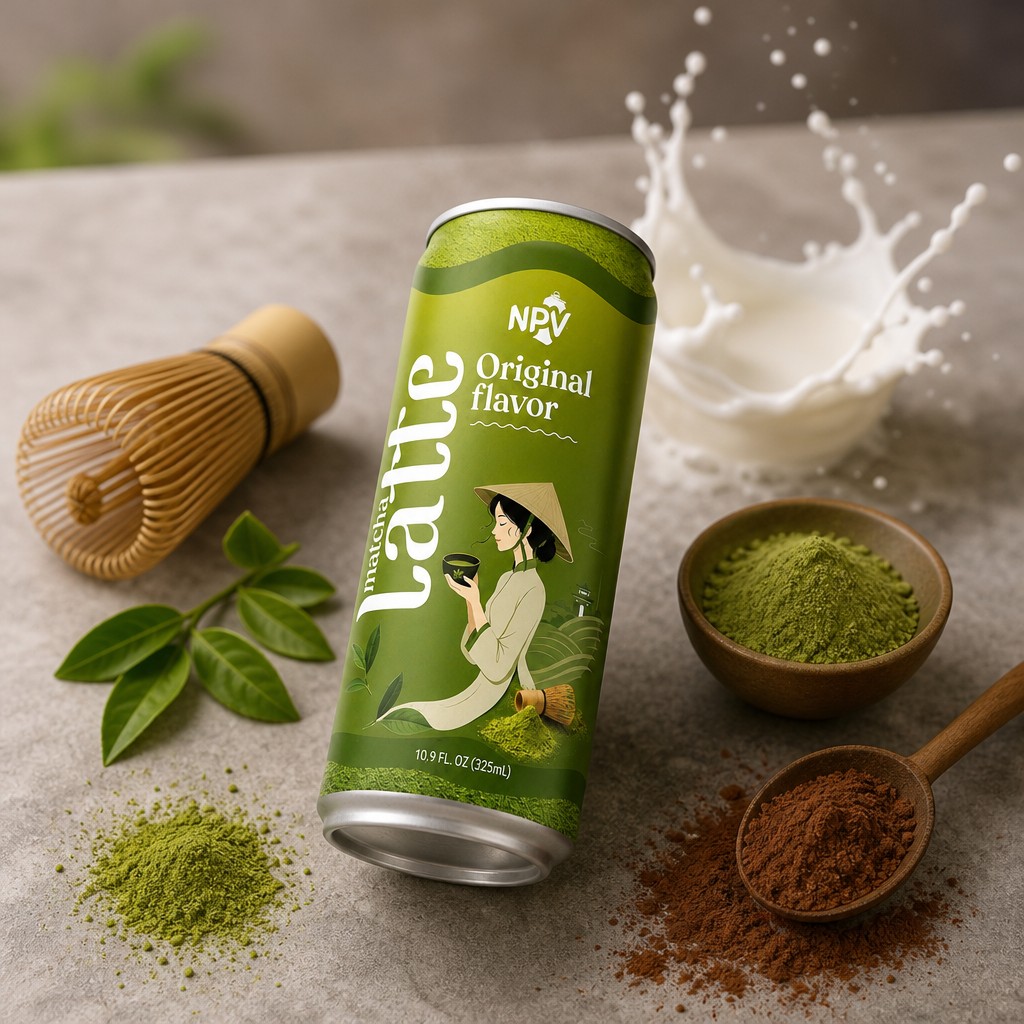
The NPV Matcha Chocolate Original is built on whole milk powder and milk protein concentrate, with matcha powder and alkalised cocoa powder supplying the flavor core. The result is a layered taste: the slightly bitter, grassy character of green tea first, followed by a rounded cocoa finish that keeps the drink from reading as a single-note sweet. As a matcha cocoa beverage, it occupies a middle ground between tea drinks and chocolate milk, which gives buyers a flexible story for mixed displays.
At 64 calories per 325ml can, the product sits at the lighter end of the RTD milk drink segment, giving it a clear role beside stronger coffee-milk products and full-sugar dairy lines. The formulation is deliberately familiar, milk, tea and cocoa, while the combination itself is distinctive enough to anchor a shelf block. Full specifications, artwork files and case configuration are published on the NPV Matcha Chocolate Original product page for buyers conducting technical review, and the wider range sits within the NPV milk drinks catalog.
Packaging That Carries a Cultural Story
The can artwork does more than decorate the shelf.
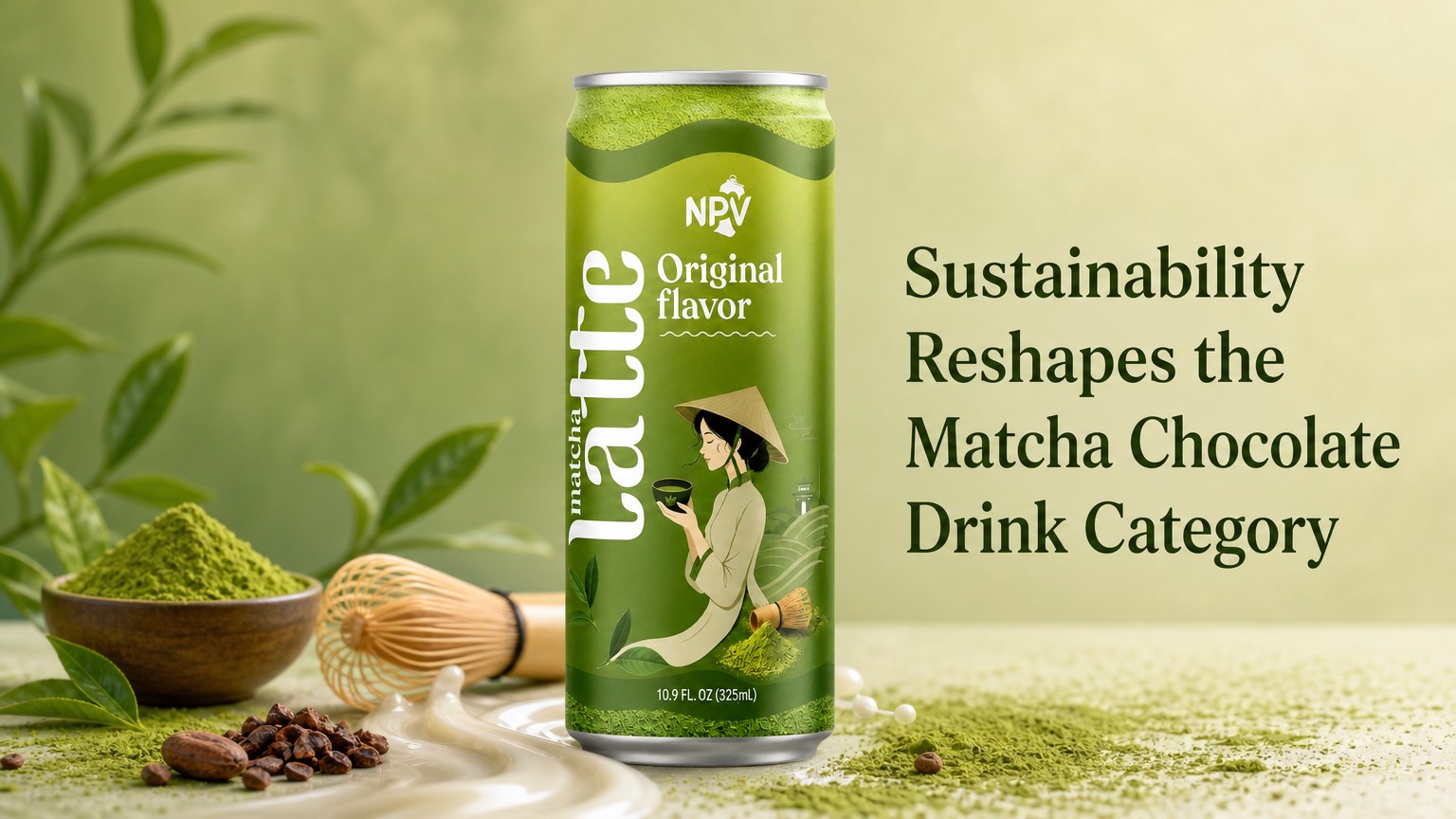
The 325ml aluminum can features an illustration of a woman in traditional Vietnamese dress holding a dark tea bowl, framed by matcha leaves, a bamboo whisk and a mound of green powder, with the words Original flavor and matcha latte set in white lettering. The design signals provenance without a wall of text, which matters on crowded international shelves where a shopper gives a package only a few seconds of attention.
Distinctive artwork also supports own-label programs. When a retail brand commissions a private label run, the same production line can carry different graphics, and NPV’s design team works with partners to adapt the visual language to local shelf conventions while keeping the base structure of the can intact. Packaging becomes a storytelling asset rather than a compliance cost.
From Vietnamese Fields to the Can: Raw Material Sourcing
Flavor consistency starts well before the production floor.
Matcha powder and cocoa powder are purchased against fixed specifications covering color, fineness, moisture and flavor intensity, and NPV works with established supply partners to hold those parameters across production runs. Consistency is what allows a distributor to reorder a private label SKU and receive a drink that matches the shelf sample approved months earlier.
The company’s broader ingredient network draws on Vietnam’s agricultural regions, and the Mekong Delta raw material area remains one of the documented sourcing zones referenced by the group for high-quality agricultural inputs used across its beverage lines.
A closer look at the sourcing landscape and the surrounding growing regions is available in this field report: https://www.youtube.com/watch?v=jiBixXjeG8A
Export Readiness and Certification Compliance
Certifications are the gate, not the garnish.
The NPV Matcha Chocolate Original is manufactured under an audited food safety management system covering the major schemes importers ask about. For a buyer entering a new territory, paperwork often decides whether a sample shipment can clear customs and reach a retail shelf at all, so the compliance package is treated as part of the product rather than an afterthought.
- BRC and FSSC 22000 for food safety management and manufacturing practice
- Halal certification under Jakim and HCA-GCC schemes for halal distribution channels
- Kosher certification for ingredient and process review
- ISO, GMP and HACCP for quality management and hazard control
- SMETA ethical trade audit for buyer qualification files
| Standard | Coverage | Why importers ask |
|---|---|---|
| BRC | Global food safety standard for manufacturing | Commonly required by large retail chains |
| FSSC 22000 | Food safety management system certification | Accepted across multiple retail audit schemes |
| Halal Jakim, Halal HCA-GCC | Suitability for halal distribution channels | Required for shelves across the Middle East and Southeast Asia |
| Kosher | Ingredient and process certification | Needed for specific retail segments in the Americas and Europe |
| ISO, GMP, HACCP, SMETA | Quality, hazard control and ethical trade audit | Baseline documentation for customs and supplier approval |
As a Vietnamese beverage exporter shipping to more than 200 countries and territories, NPV presents the compliance file alongside the product listing for the NPV Matcha Chocolate Original, so a buyer can review specifications, packaging and certification status in one place.
The 24-month shelf life at room temperature simplifies the operational side of compliance as well. Warehousing does not require temperature logs, retail handling does not depend on chilled transport, and the product remains within specification through long distribution chains in tropical and temperate climates alike.
OEM and Private Label Pathways for International Brands
Most buyers do not want a stock SKU forever.
For an OEM beverage manufacturing partner, the interesting question is how far a base formula can travel. NPV Beverage operates OEM and ODM programs covering formulation adjustment, artwork development, can size selection and scalable production, supported by capabilities shared with sister brand RITA, whose OEM service desk has handled private label briefs for international distributors for years.
A brand entering the matcha segment can start from the existing NPV Matcha Chocolate Original base and adjust sweetness, cocoa intensity, can artwork and case pack, then scale from a trial run to container-level volume without changing suppliers. Reference ranges for comparable milk-based formats are visible in the milk series catalog, which helps buyers benchmark flavor profiles and packaging options before committing to a brief.
The commercial logic is straightforward. Rather than investing in formulation work and audit cycles from scratch, a distributor can inherit a validated process, a certified facility and an export desk that already moves product across multiple continents. That shortens the path from signed contract to stocked shelf, which is the metric that matters when a retail window opens.
Market Signals Worth Watching
Recent industry news shows a sector in motion on several fronts at once. Vita Coco has raised its full-year guidance on continued demand, a reminder that established drink categories still have room to run. Keurig Dr Pepper’s U.S. antitrust case is set to proceed to trial, while Allied Blenders is facing scrutiny following a visit from Indian tax authorities. On the innovation side, the founders of Quarter Proof have launched Demi, a mid-strength spirits line aimed at emerging consumer preferences, and Albert Heijn resumed online delivery operations after a cyber outage disrupted its e-commerce platform.
For a matcha chocolate drink entering new territories, these signals matter because they describe the environment in which contracts are signed and shelves are allocated.
Guidance raises point to resilient demand, antitrust and tax headlines raise the bar on documentation quality, and a retail cyber outage is a reminder that distributors increasingly depend on digital ordering flows. An exporter that pairs a stable, ambient-storable product with a complete certification file and flexible private label capacity is better placed to absorb that volatility than one selling a single chilled SKU through a narrow channel.
Frequently Asked Questions
What is the NPV Matcha Chocolate Original?
It is a 325ml ready-to-drink milk beverage produced by NPV Beverage that combines matcha green tea powder with alkalised cocoa powder in a creamy, milk-based formulation, packaged in a printed aluminum can.
How long can the 325ml can be stored?
Unopened cans hold a 24-month shelf life at room temperature, which allows standard sea freight and ambient retail storage without chilled distribution.
Can the formulation and artwork be customized?
Yes. NPV runs OEM and ODM programs that cover flavor adjustment, artwork development, can configuration and scalable production for private label partners.
Which certifications cover production?
Manufacturing is carried out under BRC, FSSC 22000, Halal Jakim, Halal HCA-GCC, Kosher, ISO, GMP, HACCP and SMETA, supporting import requirements across major retail markets.