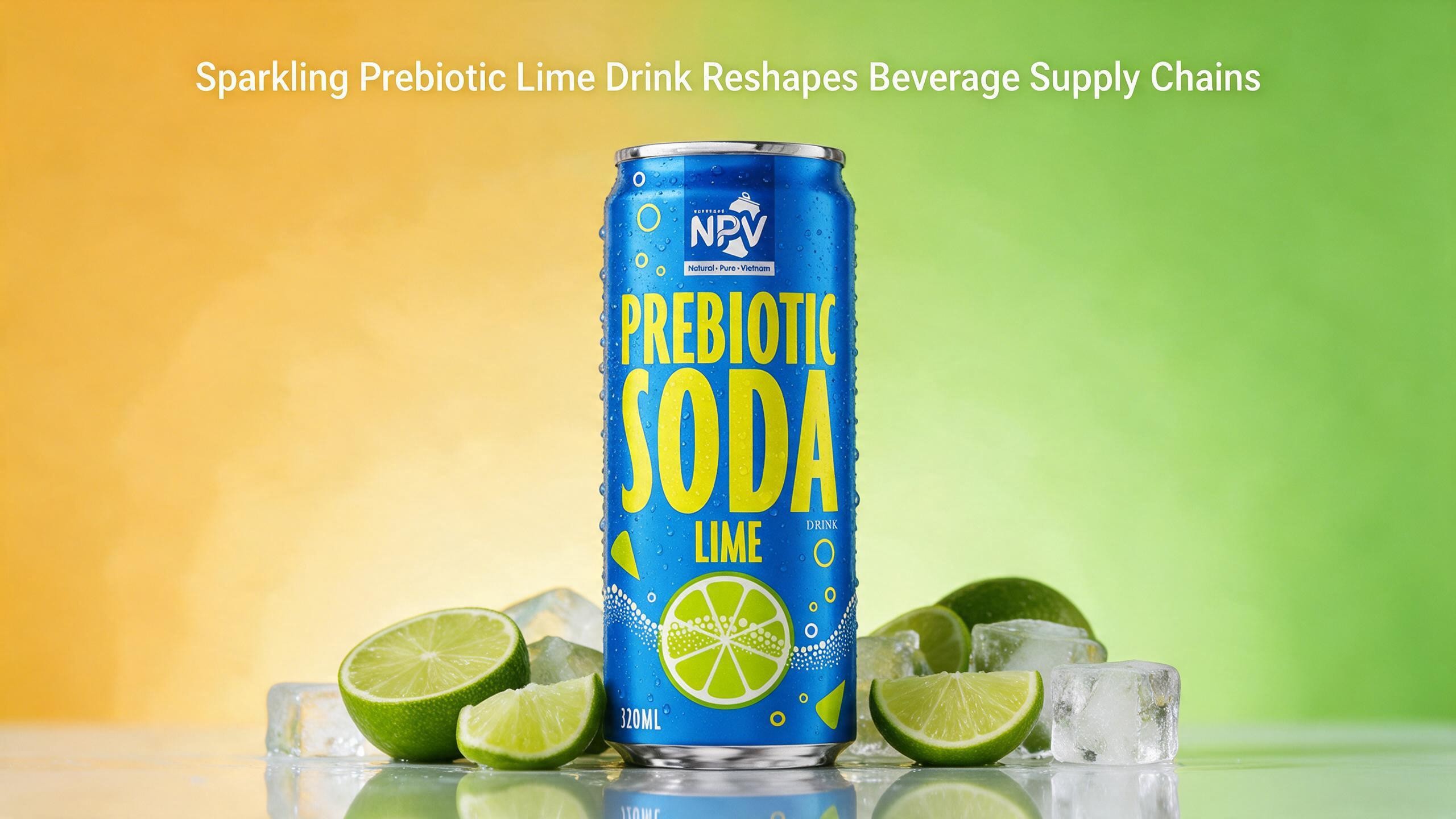
Global beverage buyers are rewriting their sourcing criteria, and the sparkling prebiotic lime drink is one of the clearest illustrations of that shift. Distributors, wholesalers and private label brand owners now weigh formulation flexibility, packaging logistics and certification depth alongside unit cost. NPV Beverage’s 320ml lime can shows how a single low-calorie SKU can anchor a much wider supply chain discussion.
Key Takeaways
- The sparkling prebiotic lime drink 320ml can pairs zero added sugar with a 15-calorie serving for retail, convenience and foodservice channels.
- Supply chain value sits in tray density, 12-month shelf life and ambient storage as much as in the recipe itself.
- BRC, FSSC 22000, Halal, Kosher, ISO, GMP, HACCP and SMETA credentials support export to more than 200 countries and territories.
- OEM, ODM and private label programs let brand owners launch the format without building production capacity.
- Prebiotic fiber such as inulin and lime flavoring reflect demand for ingredient-led, low calorie lime soda formulations.
Sparkling Prebiotic Lime Drink Reshapes Global Beverage Supply Chains
Supply chain strategy, not flavor novelty, is driving listings for this format. Buyers across Asia, Europe, the Americas, the Middle East, Africa and Oceania are consolidating SKUs around cans that travel well and hold shelf life.
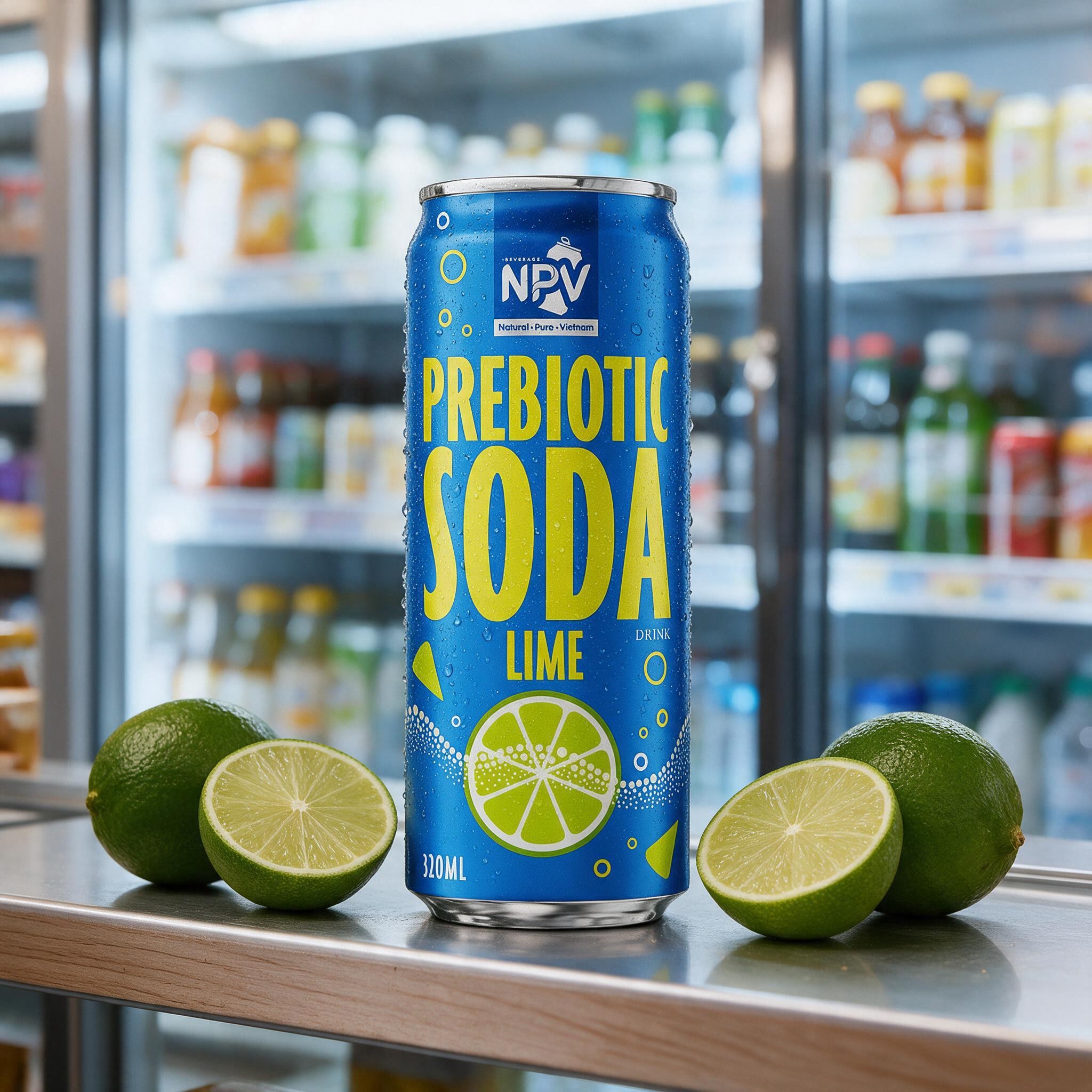
Recent industry news underlines the point. Del Monte’s investment in a Canadian protein-shake brand and Underberg’s expansion into spirits distribution both show established beverage groups widening their portfolios rather than defending narrow categories. In parallel, UK nutrient-profiling changes continue to weigh disproportionately on soft drinks, pushing formulators toward lower-calorie builds. A sparkling prebiotic lime drink answers that pressure with 15 calories per serving and zero added sugar, without giving up the carbonation shoppers expect from a sugar free lime drink.
Constellation Brands’ decision to sell a US whiskey distiller, alongside the spirits sector’s sluggish trading, sends a plainer message. Everyday-price carbonated beverages remain the volume anchor for most distributors, and that is where listing decisions tend to start.
Why the Sparkling Prebiotic Lime Drink Fits Modern Retail Formats
For most buyers the review starts with the can rather than the liquid, because format compatibility decides shelf fit.
A 320ml sleek aluminum can with a full-color printed sleeve and a hygienic pull-tab lid fits standard cooler doors, vending coils and foodservice trays without retooling. For a buyer managing dozens of SKUs, that compatibility outweighs a novel closure. The format also stacks cleanly, which keeps freight cost per unit predictable across long ocean legs.
NPV Beverage’s soft drinks catalog offers a useful reference point for seeing how lime and citrus sparkling profiles sit alongside still beverages in one range. Comparing formats side by side helps a buyer decide where a prebiotic lime can complements an existing juice or tea lineup instead of cannibalizing it.
Formulation is part of that calculus. Carbonated water, lime juice concentrate or natural lime flavoring, prebiotic fiber such as inulin, acidity regulators and natural sweeteners make up the build, with no added sugar declared on the label. The result is a crisp, zesty profile that reads as familiar on shelf while the ingredient list signals a deliberate formulation choice.
Inside the 320ml Can Supply Chain
Logistics, not label copy, decides whether a lime can survives the journey from port to shelf.
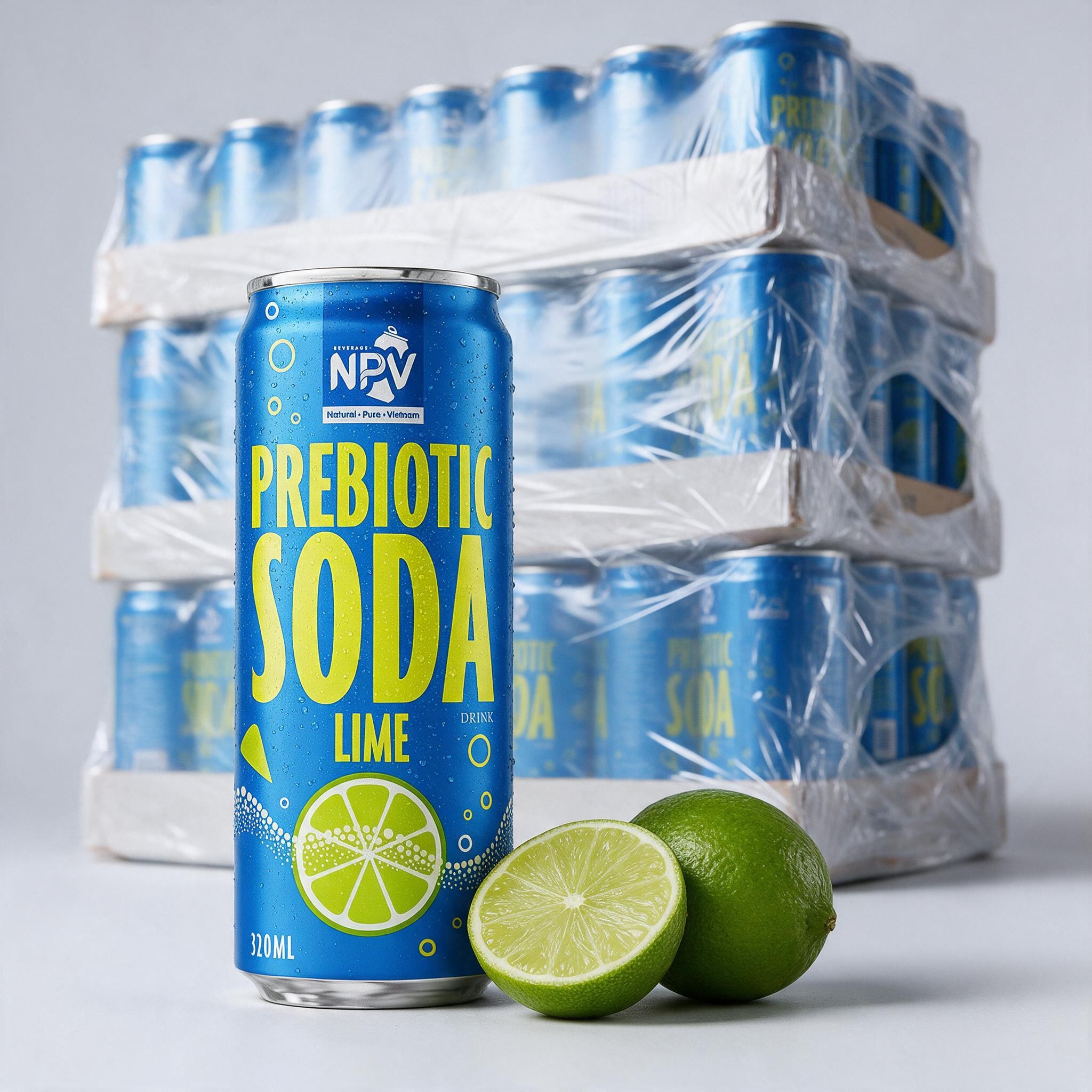
The sparkling prebiotic lime drink ships 24 cans per tray and 12 trays per pallet, a configuration designed around container utilization. Lightweight aluminum keeps tare weight low and stackable trays reduce crushing risk in mixed loads. For importers consolidating several beverage lines, that density translates directly into a lower landed cost per unit.
Case, Tray and Pallet Configuration
Standardization is where export orders succeed or stall, and freight partners plan around fixed dimensions long before a container is loaded.
NPV Beverage’s default configuration for the 320ml can is standardized for freight planning while remaining open to buyer-specific adjustments, so forwarders can book space with accurate cube calculations before production release. The core numbers below apply to both standard and private label orders.
- 24 cans per tray, supplied as shrink-wrapped tray packs
- 12 trays per pallet for bulk shipment
- Ambient storage away from direct sunlight
- 12-month shelf life measured from the production date
- Custom barcode and private label sleeve printing on request
These specifications are fixed enough for freight forwarders to plan around, yet flexible enough for buyers who need a different tray count or a mixed-pallet arrangement for a launch promotion. Shrink wrapping adds a layer of protection during transshipment, which matters on routes with several handling points before final delivery, and it keeps tray integrity intact when pallets are restacked at the destination warehouse.
| Packaging option | Best suited for | Customization available |
|---|---|---|
| Standard tray pack, 24 cans | Wholesale distribution | Custom barcode |
| Shrink-wrapped tray | Retail and cash-and-carry | Sleeve artwork |
| Private label full-color sleeve | Brand owners | Full artwork control |
| Mixed pallet arrangement | Foodservice and on-trade | By agreement |
Because the can needs no separate cold-chain planning, handover between the warehouse and the retail distribution center stays simple, and importers avoid scheduling temperature-controlled slots for a product that does not require them. That small detail removes a recurring coordination cost for teams managing mixed-category shipments.
Shelf Life and Storage for Long-Haul Routes
A 12-month shelf life gives importers room to plan seasonal orders well in advance.
Because the product stores at ambient temperature away from direct sunlight, it does not need refrigerated containers or climate-controlled warehousing before sale. That simplicity appeals to distributors building inventory ahead of peak periods, and it leaves cold capacity free for products that genuinely require it. Buyers should still confirm date-coding and labelling requirements per destination market during order confirmation.
For a 320ml can beverage supplier, ambient stability also means samples and first trial orders can move by standard courier without temperature documentation, which shortens the evaluation cycle for new buyers.
From Our Orchards: Lime Sourcing and Raw Material Supply
Ingredient sourcing sits upstream of every formulation decision and every cost conversation a buyer has.
Lime sourcing for Vietnamese beverage production draws on established growing regions, and NPV Beverage works with local partners to secure consistent supply for concentrate and flavoring. Traceable raw material flows are increasingly a procurement requirement for international buyers rather than a bonus, and buyers now ask for origin documentation alongside specification sheets.
For teams that want to understand how Vietnamese fruit sourcing is organized, the Mekong Delta raw material area report details the region that supplies much of the country’s beverage industry with fruit and plant inputs.
Field footage of the sourcing region is also available for procurement teams reviewing origin documentation: https://www.youtube.com/watch?v=jiBixXjeG8A
OEM, Private Label and Partnership Models
Most buyers of this format never intend to build a factory, and they do not need to.
NPV Beverage, established in 2019 as a Vietnamese B2B manufacturer and exporter, handles OEM/ODM and private label programs from R&D and formulation through production and global trading. The sparkling prebiotic lime drink 320ml can is offered either as a ready specification or as a base for custom development under an OEM beverage export agreement.
Companies operating at comparable scale, such as RITA Food and Drink Co., Ltd, illustrate the same model: an OEM beverage partner combining production capacity with export documentation support so brand owners can enter new markets without duplicating compliance work.
For a prebiotic soda manufacturer the commercial advantage is predictable: buyers of private label carbonated drinks move from sample to first container without capital outlay.
Flexible Packaging Options for Brand Owners
Private label work starts with artwork proofs and ends with pallet labels, and both ends demand precision because a mismatch at either stage can delay a launch date booked months earlier. Brand owners usually approve both in writing before production release.
Full-color printed sleeves, custom barcodes and shrink-wrapped tray packs let a brand owner place its own identity on a proven 320ml format. Artwork proofs, barcode registration and case-marking specifications are finalized before production release, which keeps the timeline predictable against a planned launch date.
Buyers reviewing the wider NPV range can compare the lime can against the company’s carbonated drink catalog to see how flavor variants, sweetener systems and can sizes can be combined within a single order. That flexibility matters when a distributor needs a coordinated set of sparkling SKUs rather than one isolated item.
Export Readiness and Certification Depth
Certification is the gate that decides whether an order clears customs and retail approval.
The portfolio includes BRC, FSSC 22000, Halal Jakim, Halal HCA-GCC, Kosher, ISO, GMP, HACCP and SMETA, covering the audits most importers request during supplier qualification. With exports reaching more than 200 countries and territories and a monthly capacity of 1,200 containers across 50 production lines, NPV Beverage is positioned to support repeat orders at container scale.
For procurement teams the practical question is whether a supplier can absorb a second or third order without re-qualification. The low calorie lime drink in the 320ml can is produced under the same quality systems as the rest of the line, so documentation supplied with the first order remains valid for reorders.
Halal and Kosher coverage widens the buyer pool considerably, especially where certification is a listing prerequisite rather than a differentiator.
Combined with SMETA audits and HACCP-based process control, these credentials shorten the supplier approval cycle for European and North American importers, and they give Middle Eastern and African distributors the documentation their own retail customers expect before a first container is booked.
Procurement teams can open the full product page for the sparkling prebiotic lime drink to review ingredients, packaging details and pallet configuration before requesting a sample set with certification documents attached.
Frequently Asked Questions
What is the NPV Sparkling Prebiotic Lime Drink 320ml Can?
It is a carbonated lime beverage in a 320ml aluminum can, formulated with lime flavoring, prebiotic fiber such as inulin and no added sugar, delivering 15 calories per serving. It is produced by NPV Beverage for wholesale, private label and OEM supply.
How is the product packaged for bulk shipment?
Standard configuration is 24 cans per tray and 12 trays per pallet, with shrink-wrapped tray packs, custom barcode options and private label sleeve printing available for buyers who need branded case packs.
What is the shelf life and storage requirement?
The drink carries a 12-month shelf life from the production date and stores at ambient temperature away from direct sunlight, which simplifies long-haul routing and pre-sale warehousing.
Can the drink be supplied under a private label or OEM program?
Yes. NPV Beverage supports OEM, ODM and private label projects, covering artwork, barcode registration, formulation adjustment and export documentation for brand owners entering new markets.
Which certifications support export orders?
The manufacturer holds BRC, FSSC 22000, Halal Jakim, Halal HCA-GCC, Kosher, ISO, GMP, HACCP and SMETA, with exports reaching more than 200 countries and territories worldwide.