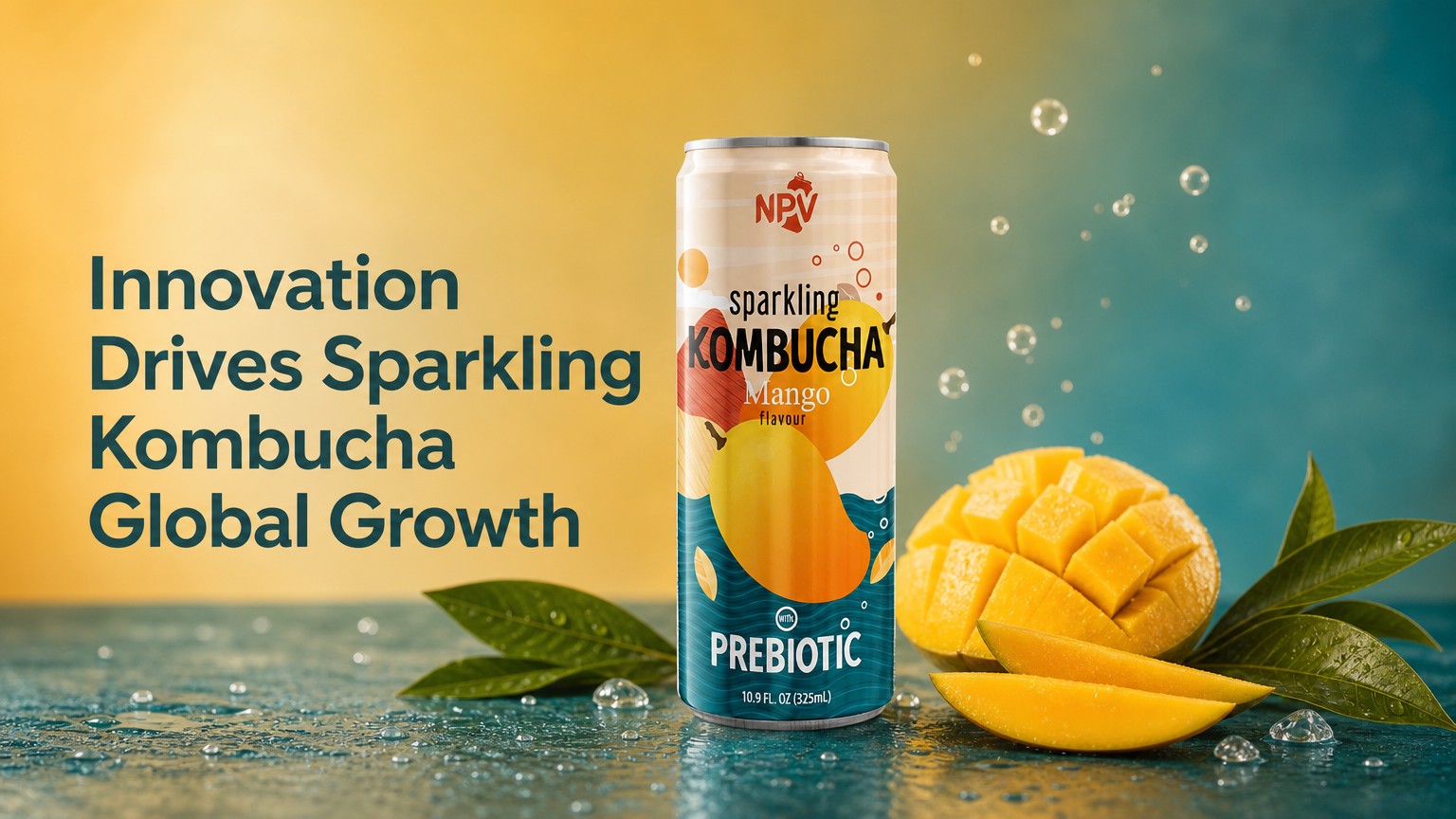
The global sparkling beverage landscape is undergoing a quiet transformation, and fermented tea is at the center of it. As consumers across Asia, Europe, the Americas, the Middle East, Africa, and Oceania look beyond traditional carbonated soft drinks, manufacturers are responding with innovative formats that blend familiar tropical flavors with modern packaging and formulation techniques. NPV Kombucha Mango Flavor is one such innovation, a sparkling fermented tea beverage presented in a sleek 325ml aluminum can that reflects where the category is heading.
Key Takeaways
- Sparkling kombucha and fermented tea formats are gaining traction among distributors and retailers worldwide.
- Mango remains one of the most requested tropical flavors in beverage innovation pipelines.
- Long shelf life and compact can packaging support global distribution and foodservice channels.
- OEM and ODM flexibility lets brand owners tailor sweetness, formulation, and artwork to regional tastes.
- Certified manufacturing across multiple international standards underpins export readiness.
Why Sparkling Kombucha Is Reshaping the Beverage Aisle
Fermented tea has moved from niche health stores to mainstream shelves, and the sparkling variant is accelerating that shift. Retail buyers report that fizzy kombucha appeals to shoppers who enjoy the mouthfeel of carbonated drinks but prefer a tea-based profile over cola or lemon-lime options. The category benefits from a dual identity: it carries the craft credibility of fermentation while delivering the refreshing sensation associated with classic sparkling beverages.
The innovation angle matters here. Rather than simply replicating still kombucha in a can, producers are engineering carbonation levels, balancing acidity with sweetness, and layering fruit concentrates to create a taste profile that travels well across cultures. Mango, with its broad recognition from Latin America to Southeast Asia, has become a natural candidate for this kind of cross-border flavor strategy.
NPV Beverage, a Vietnamese B2B manufacturer and exporter established in 2019, has positioned its NPV Kombucha Mango Flavor 325ml Can squarely in this growth pocket. The company combines research and development capability with global trading experience to serve distributors, retailers, and private label brand owners in more than 200 countries and territories.
The Mango Advantage in Formulation
Mango juice concentrate forms the backbone of the NPV Kombucha Mango Flavor, supported by natural mango flavor, cane sugar, water, citric acid, a stabilizer, and nata de coco, which adds a subtle chew to each sip. The formulation achieves its balanced taste through a combination of sucralose and acesulfame potassium, allowing the drink to land at 58 calories per 325ml can while preserving a full-bodied tropical character.
This caloric positioning aligns with what beverage category managers describe as the sweet spot for sparkling drinks: light enough for everyday consumption yet rich enough to feel like a treat. Nata de coco, a familiar ingredient across Asian and Middle Eastern markets, provides a textural cue that differentiates the product from straightforward carbonated sodas.
For buyers evaluating carbonated drink portfolios, the inclusion of a fermented tea base alongside fruit-forward flavoring opens a new merchandising story. It allows retailers to merchandise the can within both the soft drink set and the emerging fermented beverage section, effectively doubling shelf presence.
Packaging Innovation and the 325ml Can Format
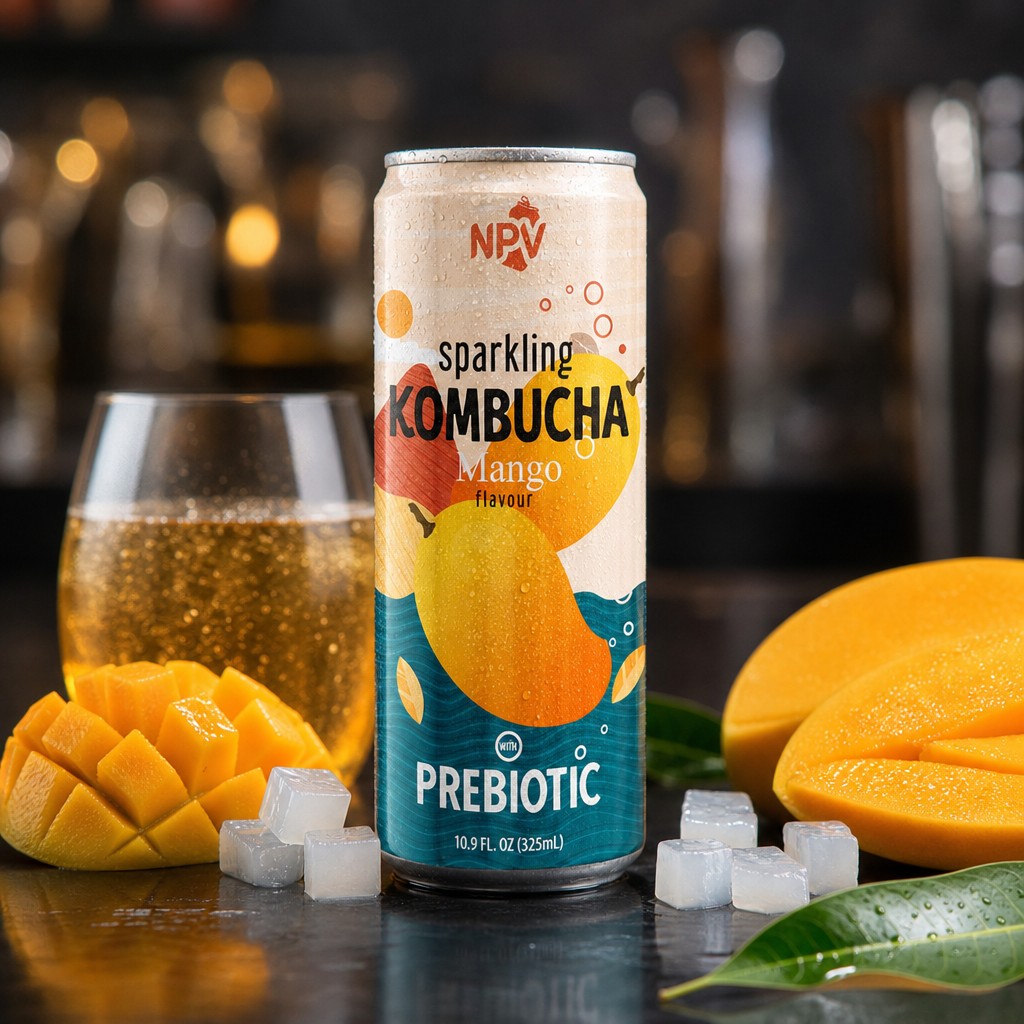
Packaging is where product innovation becomes visible on the shelf, and the 325ml aluminum can is increasingly the format of choice for export-oriented sparkling drinks. The NPV Kombucha Mango Flavor can features a cream top and teal bottom design, illustrated with ripe mangoes, wave motifs, and bubble patterns that signal the sparkling character before the tab is even pulled.
Aluminum cans offer several practical advantages for global distribution. They are lightweight relative to glass, stack efficiently in shipping containers, chill quickly in retail coolers, and are widely accepted by recycling programs in Europe and North America. For foodservice operators, the single-serve format eliminates waste and simplifies portion control.
Shelf Life as a Commercial Enabler
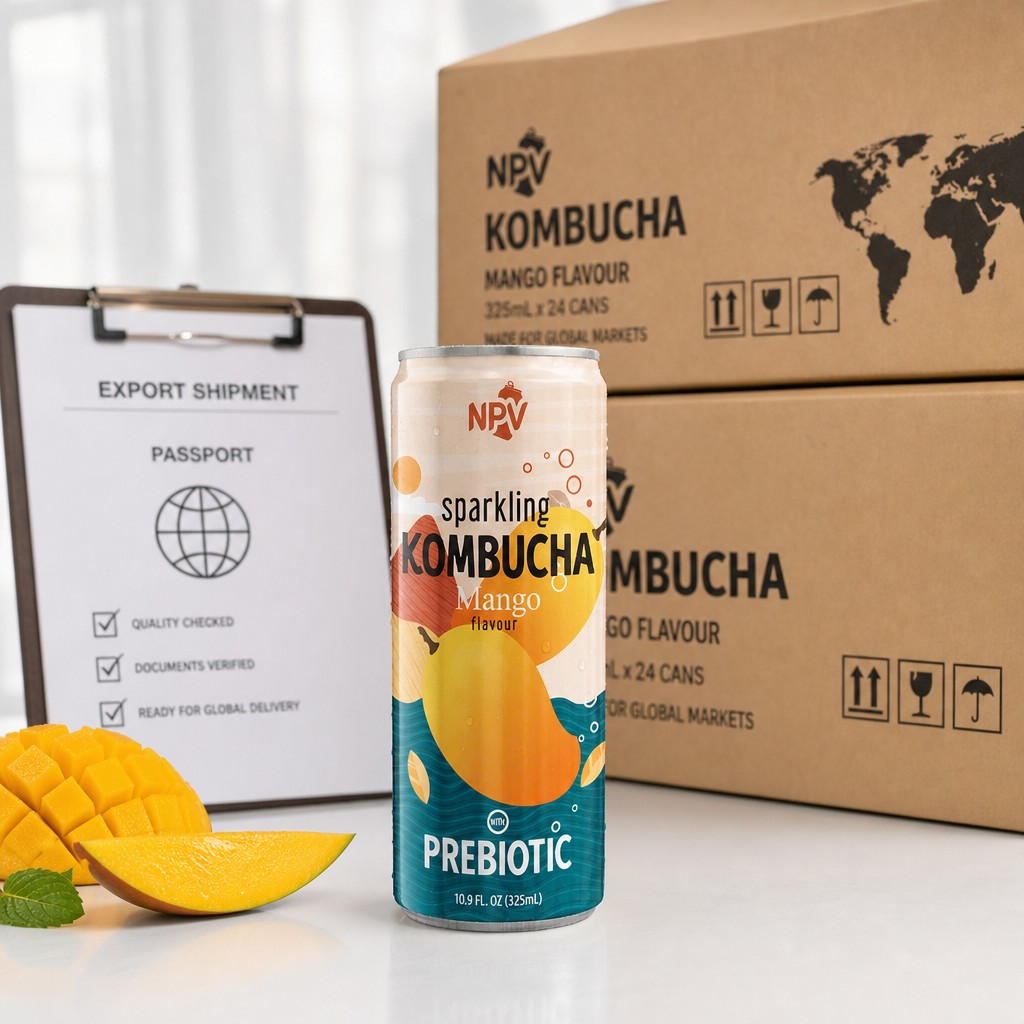
A 24-month shelf life transforms the logistics equation for importers. Long-distance freight, port delays, and extended warehouse storage become manageable rather than risky, giving distributors the confidence to place larger orders and maintain buffer stock in secondary markets. This is particularly relevant for buyers serving Africa and Oceania, where supply chains are longer and inventory turnover can be slower.
The combination of a durable can and extended shelf life also supports e-commerce fulfillment. Sparkling drinks shipped through third-party logistics providers benefit from packaging that withstands temperature fluctuations and handling without compromising the carbonation level or label integrity.
NPV Beverage’s approach to packaging extends beyond the standard catalog. Through custom packaging options for NPV Kombucha Mango Flavor, clients can commission artwork tailored to local retail conventions, from multilingual labeling to region-specific color palettes and promotional callouts.
From Our Orchards and Waters: Raw Material Sourcing
Flavor consistency starts at the source, and Vietnamese agriculture provides a strong foundation for tropical beverage production. The country’s mango-growing regions supply concentrate that carries the aromatic depth required for fermented tea blends, while established supply networks for cane sugar and nata de coco keep formulation stable across production runs.
Partnerships with local farms allow beverage manufacturers to trace raw materials and maintain specifications from harvest to canning. This supply chain visibility is increasingly requested by retail buyers in Europe and the Americas, who audit ingredient origins as part of their vendor qualification process.
The broader sourcing ecosystem in the Mekong Delta has long been recognized as a high-quality raw material base for the beverage industry. According to the Mekong Delta fruit farm supply area, the region’s climate and soil conditions support consistent fruit quality that translates into reliable juice concentrates.
Mango sourcing specifically benefits from dedicated orchard networks. The journey from orchard to concentrate is documented in the mango farm to premium mango juice process, which illustrates how fruit selection, ripeness control, and processing standards combine to produce concentrate suitable for sparkling applications.
For a visual overview of the orchards behind this supply chain, the following footage captures the mango sourcing environment firsthand.
Manufacturing Credentials Behind the Innovation
Behind every innovative product is a manufacturing platform that can deliver it consistently at scale. NPV Beverage holds an international certification portfolio that includes BRC, FSSC 22000, Halal Jakim, Halal HCA-GCC, Kosher, ISO, GMP, HACCP, and SMETA, covering the regulatory expectations of buyers in every major region.
Halal certification opens doors across the Middle East and Southeast Asia, while Kosher and BRC credentials support placements in North American and European retail chains. FSSC 22000 and HACCP address food safety management requirements that large-scale importers increasingly make non-negotiable in supplier audits.
These credentials are not simply badges. They represent documented processes for hazard control, traceability, allergen management, and social compliance that survive the scrutiny of third-party auditors. For a category as sensitive as fermented beverages, where pH control and microbiological stability are critical, this infrastructure is a competitive differentiator.
OEM and ODM Flexibility for Brand Owners
Innovation in the beverage sector is rarely a solo endeavor. Many of the most successful sparkling drink launches originate from OEM and ODM partnerships, where an established manufacturer produces a formula under a client’s brand. NPV Beverage offers both OEM and ODM services, allowing clients to specify sweetness levels, carbonation intensity, flavor ratios, and packaging artwork.
This model mirrors what RITA, a Vietnamese beverage manufacturer with deep OEM and export experience, offers to international buyers seeking private label solutions across fruit juice, coconut water, and soft drink categories. The parallel capability across Vietnamese manufacturers gives global brand owners a competitive sourcing landscape to negotiate within.
For clients exploring broader portfolios, the same manufacturing partner can extend into fruit juice lines, enabling consolidated shipments and simplified vendor management. A distributor carrying both sparkling kombucha and still juice from a single certified facility reduces audit overhead and freight complexity.
The flexibility extends to formulation science. A client targeting the European market might request lower sweetness and a drier finish, while a buyer serving the Middle East could opt for a more pronounced mango profile. The NPV Kombucha Mango Flavor 325ml Can serves as a proven baseline from which these variations are developed.
Market Opportunities Across Regions
The addressable market for sparkling fermented tea spans every inhabited continent. In Asia, kombucha awareness is high and consumers are receptive to fruit-forward variants. Europe presents a mature kombucha audience that increasingly shops in mainstream grocery channels rather than specialty stores. The Americas offer scale, with the United States alone representing a significant share of global kombucha consumption.
The Middle East and Africa present a different opportunity profile. Halal-certified sparkling drinks with tropical flavors align with the region’s taste preferences and regulatory requirements, while Oceania’s import-dependent retail landscape rewards products with long shelf life and reliable supply.
| Region | Key Buyer Profile | Primary Appeal |
|---|---|---|
| Asia | Modern trade and convenience chains | Familiar mango flavor, can format |
| Europe | Grocery multiples and specialty retailers | Fermented tea story, recyclable packaging |
| Americas | National distributors and private label brands | Scalable OEM formulation |
| Middle East | Halal-certified importers | Certification coverage, tropical profile |
| Africa | Regional wholesale distributors | 24-month shelf life, durable can |
| Oceania | Independent retailers and foodservice | Single-serve format, export logistics |
Market segmentation overview compiled by NPV Beverage for buyer reference.
Trade publications including BeverageDaily and FoodNavigator have consistently tracked the convergence of sparkling formats with functional-adjacent flavor stories, a trend that favors products like mango kombucha sitting at the intersection of two consumer interests.
Competitive Positioning and Category Context
The broader beverage industry is experiencing its own wave of strategic realignment. Abbott’s plan to spin off its nutrition business into a standalone company signals how major players are sharpening focus on individual categories. Nestlé, meanwhile, continues to progress toward mid-term targets even as external risks such as the potential seizure of Russian assets test scenario planning. These corporate moves matter to beverage buyers because they reshape supplier relationships, portfolio priorities, and distribution agreements across the value chain.
On the spirits side, spritz growth is accelerating, with Amante 1530 stating that the category’s expansion is only beginning, while vermouth brand Strucchi’s entry into the US market illustrates how new entrants are challenging established players. Even Heineken’s recent order to pay damages in a Greek competition case underscores the regulatory scrutiny that shapes competitive dynamics. For non-alcoholic sparkling drinks, these developments create a favorable backdrop: consumers exploring spritz-style refreshment are primed to consider sophisticated, flavor-led soft drinks.
Within this context, NPV Kombucha Mango Flavor occupies a defensible position. It is not competing directly with alcohol, but it benefits from the same consumer curiosity about layered flavors, effervescence, and elevated drinking occasions. The 58-calorie count and 325ml can make it an easy substitution in situations where a spritz or sparkling wine might otherwise be considered.
What Buyers Should Evaluate
Procurement teams assessing a new sparkling drink SKU typically weigh several factors beyond taste. Certification coverage, minimum order quantities, lead times, and packaging customization options all influence the go/no-go decision.
- Certification breadth — BRC, FSSC 22000, Halal, Kosher, ISO, GMP, HACCP, and SMETA reduce the need for market-specific supplier vetting.
- Shelf life — 24 months supports long-haul freight and extended inventory planning.
- Format — 325ml aluminum can suits single-serve retail and foodservice alike.
- Customization — OEM and ODM services cover formulation, sweetness, and artwork changes.
- Export footprint — shipments to 200+ countries and territories demonstrate proven logistics capability.
Buyers who already source other categories from Vietnamese manufacturers may find that adding a sparkling kombucha line consolidates their supply base. The same due diligence applied to coconut water or juice imports can be extended to fermented tea with minimal incremental effort.
Looking Ahead
Innovation in sparkling beverages will continue to be driven by three forces: flavor exploration, packaging efficiency, and formulation precision. Mango kombucha in a 325ml can sits at the intersection of all three, offering a product that is recognizable in flavor, practical in format, and engineered for the realities of global trade.
For distributors and brand owners evaluating their next sparkling drink addition, the combination of certified manufacturing, customizable formulation, and a shelf-stable can format makes NPV Kombucha Mango Flavor 325ml Can a product worth sampling. As the category matures, the manufacturers who pair genuine R&D capability with export-ready infrastructure will define what consumers find on shelves from Tokyo to Toronto, Dubai to Sydney.
Frequently Asked Questions
What is NPV Kombucha Mango Flavor 325ml Can?
NPV Kombucha Mango Flavor is a sparkling fermented tea beverage produced by NPV Beverage, a Vietnamese B2B manufacturer and exporter. It is formulated with mango juice concentrate, natural mango flavor, cane sugar, citric acid, nata de coco, and balanced sweeteners, and packaged in a 325ml aluminum can with a 24-month shelf life.
Which markets can import this sparkling kombucha?
The product targets distributors, retailers, and brand owners across Asia, Europe, the Americas, the Middle East, Africa, and Oceania. NPV Beverage exports to more than 200 countries and territories and holds certifications including BRC, FSSC 22000, Halal, Kosher, ISO, GMP, HACCP, and SMETA.
Can the formulation and packaging be customized?
Yes. NPV Beverage offers OEM and ODM services that allow clients to adjust sweetness levels, flavor ratios, carbonation, and packaging artwork to match regional preferences and retail requirements.
How many calories are in one can?
Each 325ml can of NPV Kombucha Mango Flavor contains 58 calories, with a balanced sweetness profile achieved through a blend of cane sugar, sucralose, and acesulfame potassium.
What is the shelf life of the product?
The product carries a 24-month shelf life, making it suitable for long-distance distribution, extended warehousing, and e-commerce fulfillment across global supply chains.