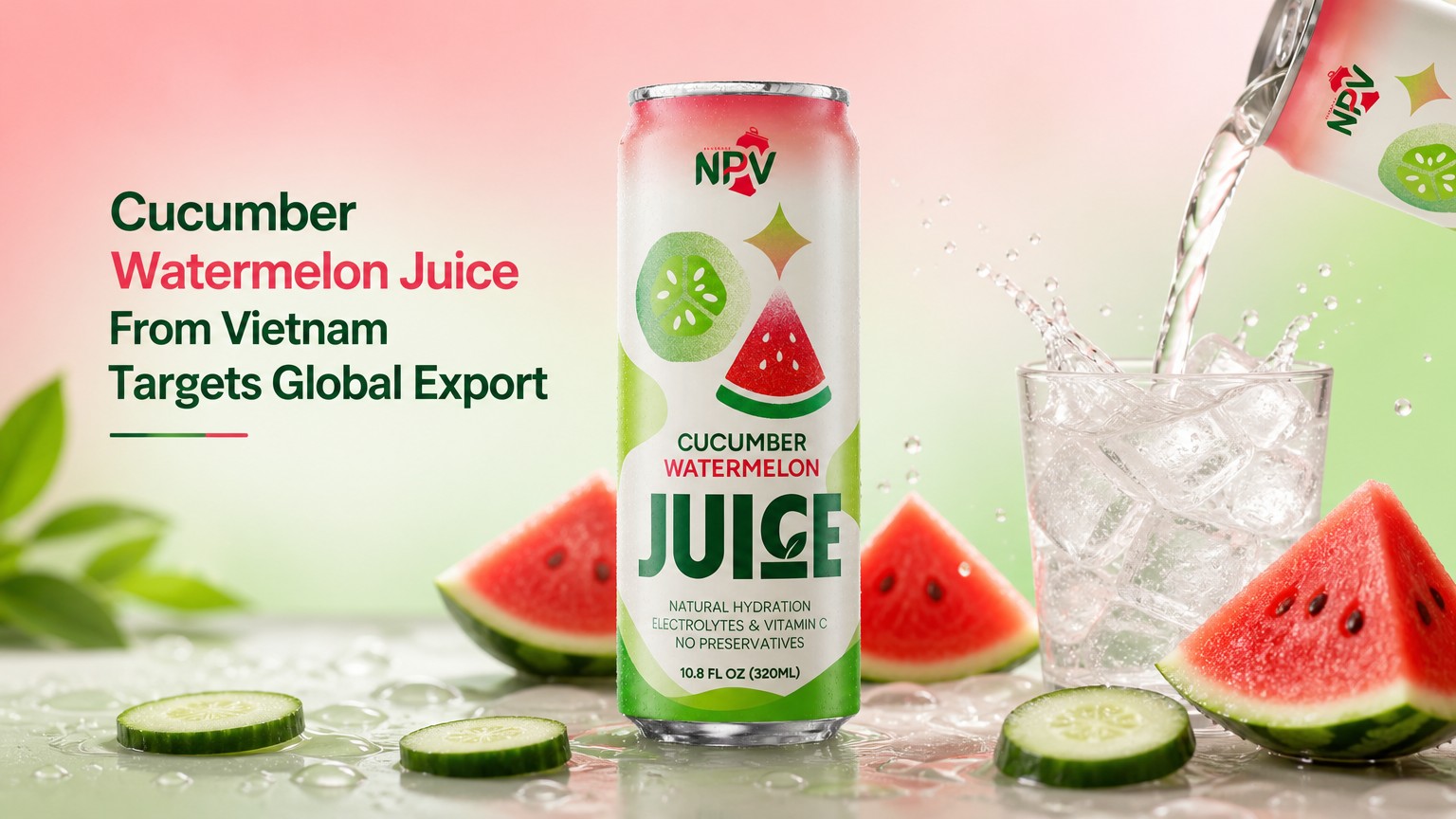
The global beverage trade is gravitating toward lighter, fruit-forward formats, and cucumber watermelon juice has become one of the more visible newcomers in that shift. NPV Beverage, the export business of Nguyen Pham Viet Beverage Co., Ltd., is marketing the drink in a 320ml slim aluminum can for retail shelves and private label programs across Asia, Europe, the Americas, the Middle East, Africa and Oceania. The release lands as importers weigh clean-label juice options with transparent ingredient lists and packaging that holds up over long supply routes.
Key Takeaways
- NPV Beverage ships a cucumber and watermelon juice blend in a 320ml slim can to more than 200 countries and territories.
- The label lists cucumber and watermelon juices with electrolytes and vitamin C, and no preservatives.
- Certification coverage spans BRC, FSSC 22000, Halal Jakim, Halal HCA-GCC, Kosher, ISO, GMP, HACCP and SMETA.
- OEM and private label programs let international brands launch their own version of the drink through Vietnamese manufacturing partners.
- Trade commentators describe spritz-style and lightly refreshing cans as still sitting in an early growth phase.
Cucumber Watermelon Juice Finds a Niche in Global Beverage Trade
Importers across six continents are ordering smaller, lighter cans as shelf space tightens and grab-and-go formats claim more floor area.
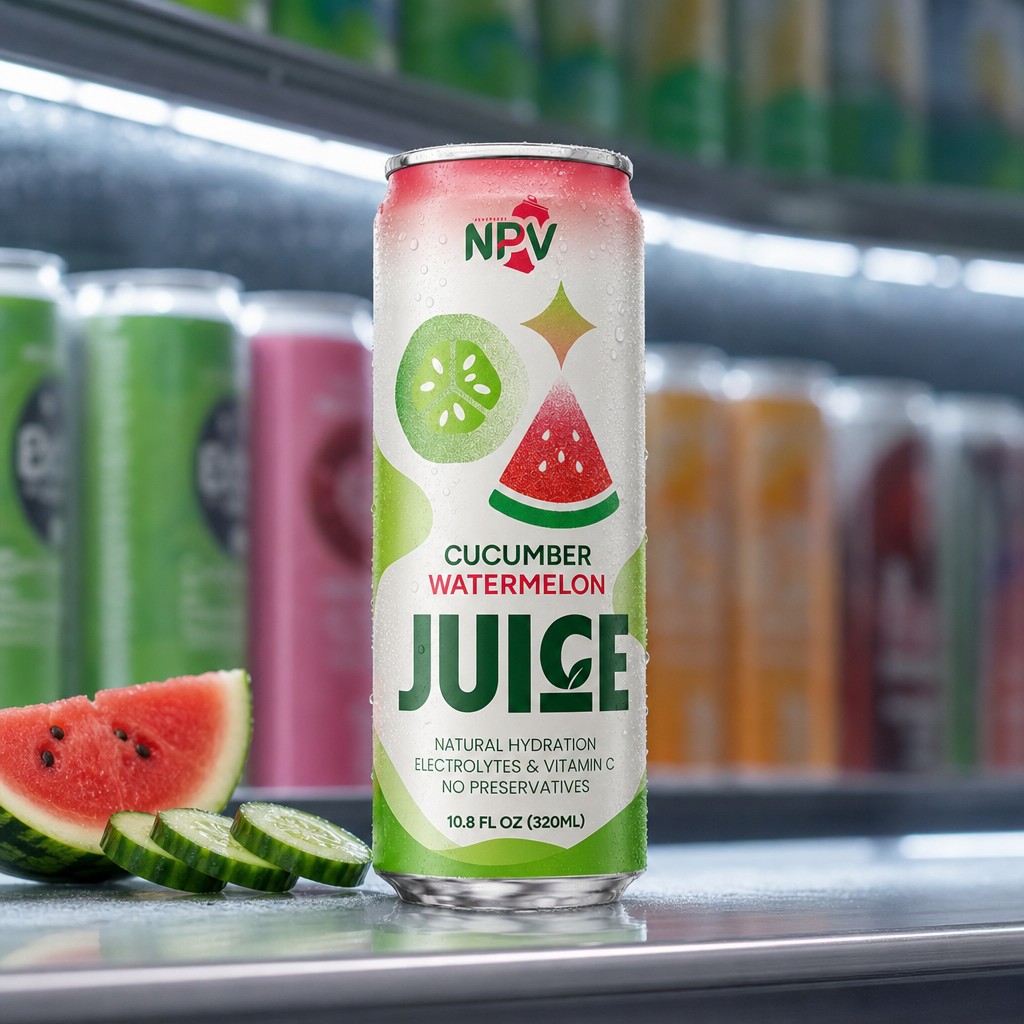
The timing matters for anyone building a forward buying calendar. Category commentary has described spritz-type drinks as still sitting in an early growth phase with meaningful upside ahead, a signal that lightly refreshing, low-weight cans are expanding rather than maturing. Against that backdrop, a juice built on a crisp cucumber note and juicy watermelon sweetness reads less like a novelty and more like a repeat-order item for convenience stores, cafes and modern grocery outlets. Buyers in warm-climate markets are especially attentive to formats that move through long distribution chains without the breakage exposure of glass.
Spritz Culture and the Slim-Can Format
The slim can has quietly become the default silhouette for premium small-format drinks across several regions.
Its narrow profile photographs well, stacks efficiently in secondary packaging, and gives designers a tall canvas for gradient labels and fruit illustrations. For a cucumber and watermelon blend, that canvas is used with a pink-to-green gradient and dotted fruit artwork that signals the flavor before the tab is pulled. The format also supports chilled placement near checkout, where the purchase decision is made in seconds rather than minutes, and it sits naturally beside items in the soft drinks range that buyers already stock.
What International Buyers Ask for in a Slim-Can Juice
Procurement teams reviewing a new juice line tend to care about paperwork more than prose.
Distributor questionnaires circle the same points when a product is first presented: can it clear customs, does the label hold its claim, and will the packaging arrive intact. For an electrolyte juice drink in aluminum, the answers are usually favorable, since cans travel well in containerized freight and require no returnable packaging logistics.
- Ingredient transparency, with a short list that reads clearly on a multilingual label.
- Shelf-stable packaging suited to containerized freight and mixed-pallet orders.
- Case and pallet configurations that match local warehouse racking.
- Artwork files and dielines ready for private label adaptation.
- Certification documents aligned with the destination market’s import requirements.
Formulation and Packaging Behind the NPV Cucumber Watermelon Juice
Two fruits, two added minerals and a single vitamin carry the entire label of this drink.
The product is built as a clean-label blend: cucumber juice and watermelon juice form the base, with electrolytes and vitamin C added to the composition and no preservatives used. The profile is light and garden-fresh, avoiding the heaviness of denser nectars while still delivering enough fruit character to stand on its own rather than as a mixer. For buyers, the short ingredient list is the headline. It simplifies label copy, reduces translation work across markets, and matches the demand for transparent formulations that has reshaped juice aisles in recent years. Full pack details, volume and formulation notes are published on the cucumber watermelon juice product page, where export partners can review specifications before requesting samples.
Flavor Balance Between Cucumber and Watermelon
Cucumber brings a dry, vegetal crispness while watermelon supplies sweetness, volume and a deep red color.
Balancing the two is a matter of ratio rather than sweetener, and the pairing produces a profile that sits between a juice and a refreshment can. It is a combination that travels well conceptually: both fruits are broadly recognized, visually distinct and easy to illustrate on a label, which matters when the same artwork must work in Jakarta, Dubai and Rotterdam. The blend also gives exporters a talking point that does not require translation.
The 320ml Slim Can as a Retail Format
Volume choice is a commercial decision as much as a design one for export buyers.
At 320ml, the can lands below the standard 330ml and 355ml sizes common in Western retail, giving buyers a price-point option that fits chilled single-serve placements while still feeling substantial in the hand. The aluminum body performs reliably through thermal processing and long transit legs, and it is fully recyclable, a point that European and Australian importers increasingly raise in tender documents. Slim profiles also raise pallet density, which trims the per-unit freight cost on long routes.
| Format | Typical Volume | Retail Positioning | Freight Profile |
|---|---|---|---|
| NPV slim can | 320 ml | Chilled single-serve and premium juice shelves | Lightweight, high pallet density |
| Standard can | 330 to 355 ml | Mainstream soft drinks and mixers | Comparable weight, wider footprint |
| PET bottle | 300 to 500 ml | Take-home and mass retail | Higher volume per unit, shape-dependent stacking |
Raw Material Sourcing in the Mekong Delta
Fruit quality is decided long before a can is filled, starting in the fields of the delta.
Watermelon and cucumber cultivation in southern Vietnam is concentrated in the Mekong Delta, where alluvial soils and a warm growing calendar support several harvests each year. NPV’s sourcing relationships in the region give the company predictable raw material flows during peak export seasons, which matters when a buyer is scheduling container bookings months ahead. Field teams monitor sugar levels and flesh color before harvest, the two attributes that most influence the final juice profile once the fruit is pressed.
The wider sourcing landscape is set out in a field report describing the Mekong Delta as a high-quality raw material area for juice production across southern provinces.
Footage from the growing areas offers a direct look at the sourcing base behind Vietnamese juice exports: https://www.youtube.com/watch?v=jiBixXjeG8A
Export Readiness and Certification Coverage
Certificates decide whether a can clears the port, and this SKU arrives with a full set.
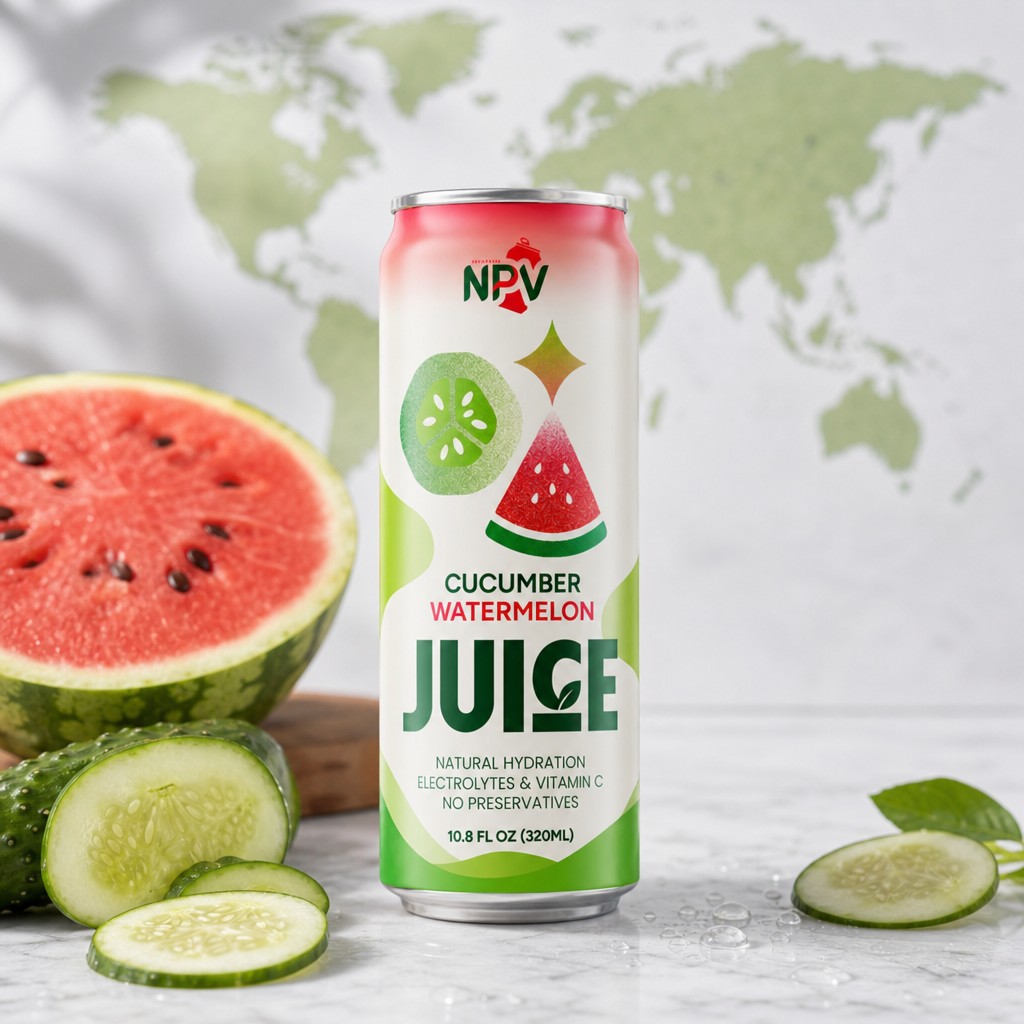
NPV’s documentation set is built for multi-market distribution rather than a single destination. The company holds BRC and FSSC 22000 food safety certifications alongside ISO and GMP systems, HACCP-based process controls, SMETA social compliance auditing, and both Halal Jakim and Halal HCA-GCC approvals plus Kosher certification. That combination covers the practical checkpoints for buyers in the Gulf, Southeast Asia, Europe and North America without requiring separate production runs for each destination. Shipments have reached more than 200 countries and territories, giving this Vietnam beverage exporter familiarity with varied customs paperwork, labeling rules and shelf-life expectations. The 320ml cucumber watermelon juice listing carries the pack specification that buyers attach to their import files.
| Certification | Where It Typically Matters |
|---|---|
| BRC, FSSC 22000 | UK and EU retail audit schemes |
| Halal Jakim | Southeast Asian markets |
| Halal HCA-GCC | Gulf Cooperation Council states |
| Kosher | North American and European specialty retail |
| ISO, GMP, HACCP | Baseline manufacturing controls across regions |
| SMETA | Ethical audit requirements of European and US importers |
Target Markets Across Six Continents
The same 320ml can is being positioned across very different retail environments on six continents.
In Asia, the drink is slotted into convenience store chillers alongside other fruit-forward cans. In the Gulf, Halal approvals remove a common barrier to entry. European and North American buyers tend to ask first about the ingredient list and the audit certificates, while distributors in Africa and Oceania look at case configuration and landed cost. One specification, six regional conversations, and no reformulation in between.
OEM and Private Label Pathways for International Brands
Third-party production is where a growing number of importers find their margin in beverages.
Both NPV and RITA operate as Vietnamese OEM and ODM beverage manufacturers, handling recipe development, can sourcing, label printing and export documentation under one roof. RITA’s fruit juice product range shows the breadth of formats available to partners, from single-fruit juices to blended refreshments built on the same production logic as a cucumber-watermelon line. For a distributor that wants a house brand rather than a resale relationship, this route removes the capital cost of a filling line while keeping control of formulation and artwork. It is the model behind much of the region’s OEM juice manufacturing.
The NPV fruit juice catalog groups the company’s juice offerings for buyers comparing categories, while the cucumber watermelon juice page carries the specific pack details for this SKU. Teams that prefer to benchmark across Vietnamese suppliers often start with RITA’s fruit juice products catalog before narrowing a shortlist of private label juice supplier candidates.
Launching a Cucumber Watermelon Juice Line
A private label launch for this flavor usually follows the same sequence.
- Brief and target market definition, including volume, label language and certification needs.
- Sample evaluation against the buyer’s flavor and sweetness benchmarks.
- Artwork adaptation using the supplier’s dieline, with legal copy reviewed per destination.
- Trial production run and shelf-life verification documentation.
- Shipment scheduling, with case and pallet layouts confirmed before booking.
Timelines vary with artwork approval and certificate requirements, but the structure keeps a first order moving without repeated reformulation. Buyers who plan the certification step early typically reach their first container faster.
Outlook for the Light Juice Segment
The wider industry backdrop is being redrawn by portfolio decisions at several large groups.
Nestle has indicated it is on track to meet its mid-term targets even as an asset seizure in Russia complicates its operations, while Abbott has announced plans to spin off its nutrition business as a standalone company. Both moves point the same direction: nutrition-adjacent portfolios are being sharpened and separated for focus. Meanwhile, Heineken’s damages order in a Greek competition case and Strucchi’s entry into the U.S. market show that even mature categories are still shifting ground. For smaller exporters, that churn creates openings on shelves where buyers are actively reworking their line-ups.
Against that backdrop, a cucumber watermelon juice in a slim can offers a low-risk addition to a portfolio: a recognizable flavor pairing, a short label, a format that ships well, and a certification stack that already covers most import destinations. NPV’s fruit juice export program supports that proposition with OEM capacity, private label flexibility and an export footprint spanning more than 200 countries and territories.
Frequently Asked Questions
What ingredients are listed in NPV Cucumber Watermelon Juice?
The drink combines cucumber juice and watermelon juice with added electrolytes and vitamin C. No preservatives are used, and the full ingredient list appears on the can label and on the product page for export buyers.
What packaging format does the product use?
It is filled in a 320ml slim aluminum can with a pink-to-green gradient label. The format is designed for chilled single-serve placement and ships in standard export case and pallet configurations agreed with each distributor.
Which certifications support export of this juice?
NPV holds BRC, FSSC 22000, Halal Jakim, Halal HCA-GCC, Kosher, ISO, GMP, HACCP and SMETA. Together these cover the audit and religious certification requirements most often requested by importers in Asia, the Gulf, Europe and the Americas.
Can the drink be produced under a private label?
Yes. Both NPV and RITA offer OEM and ODM programs covering recipe development, artwork adaptation, can supply and export documentation, so a distributor can launch the same formulation under its own brand.
Which markets does NPV export to?
The company reports shipments to more than 200 countries and territories, spanning Asia, Europe, the Americas, the Middle East, Africa and Oceania, with the cucumber watermelon juice positioned for retail and wholesale channels in each region.