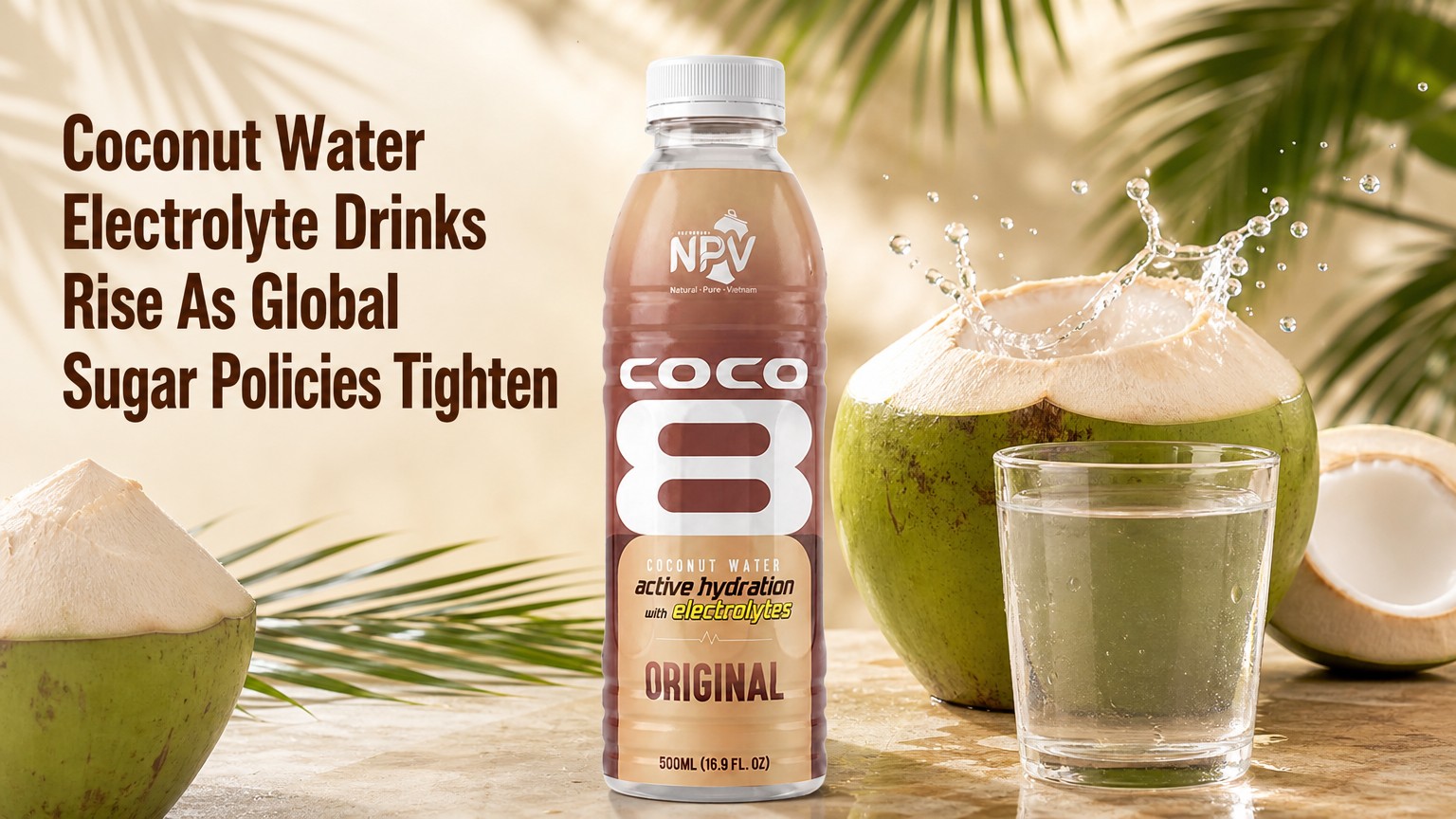
The global beverage industry is entering a period of significant regulatory and consumer transformation, and coconut water electrolyte drinks are positioned at a fascinating crossroads of this shift. As governments from Europe to Asia evaluate sugar taxation frameworks and consumers increasingly scrutinize ingredient labels, naturally sourced hydration beverages are drawing fresh attention from retailers, distributors, and private label buyers worldwide. Against this backdrop, NPV Beverage has introduced its NPV COCO 8 Original Coconut Water Electrolyte Drink, a 500ml PET bottle crafted from pure Vietnamese coconuts, offering international buyers a clean-label option aligned with emerging market demands.
Key Takeaways
- Germany’s reported backing of a sugar tax plan signals further regulatory momentum across European beverage markets.
- Naturally sourced coconut water drinks are gaining traction as formulators seek alternatives to sugar-heavy beverages.
- NPV COCO 8 combines pure Vietnamese coconut water with a resealable 500ml PET format suited for retail and foodservice.
- Certifications including BRC, FSSC 22000, Halal, and Kosher position the product for multi-market distribution.
- OEM and private label programs enable brands to localize packaging and flavors for regional preferences.
Regulatory Pressure Reshapes the Global Beverage Landscape
Sugar policy is no longer a peripheral concern for beverage manufacturers. It is now a central planning variable.
Recent industry developments underscore how quickly the regulatory environment is moving. Germany has reportedly backed a sugar tax plan that would add another layer of fiscal pressure on sweetened drink categories across one of Europe’s largest consumer markets. Meanwhile, in the spirits sector, Diageo has seen strike action suspended ahead of further negotiations, and talks around the asset sale of Uncle Nearest continue to unfold, illustrating the broader volatility shaping the drinks trade. In the Baltics, Latvia’s tax authority has frozen accounts belonging to Amber Latvijas Balzams, a reminder that fiscal compliance remains a live risk for beverage operators. Even corporate expansion strategies are shifting, with Hijos de Rivera establishing a German subsidiary to navigate a market poised for tighter oversight.
For importers and distributors, these signals point in one direction: the cost of carrying high-sugar beverage portfolios is set to rise. Retailers are already re-evaluating shelf allocation, and buyers are proactively sourcing alternatives that can withstand future levies without sacrificing consumer appeal. This is where products like the NPV 500ml Original Coconut Water Electrolyte Drink find strategic relevance. With a formulation based on natural coconut water and no artificial colors or preservatives, it sidesteps the reformulation burden that sugar taxes impose on conventional soft drinks.
Market watchers note that the ripple effects extend beyond Europe. Asia-Pacific regulators are observing European tax experiments closely, and several Middle Eastern and African markets are reviewing similar frameworks as part of broader public health policy agendas. For beverage exporters, this means product selection decisions made today will determine portfolio resilience for the next decade.
Coconut Water and the Clean Label Consumer Shift
Consumer preference for transparent ingredient lists is accelerating across virtually every major beverage category.
The coconut water segment has benefited disproportionately from this shift. Shoppers increasingly parse labels for recognizable ingredients, and coconut water’s naturally occurring electrolyte profile offers a straightforward story that requires little marketing embellishment. Light sweetness, a refreshing mouthfeel, and a short ingredient deck are attributes that resonate with today’s label-conscious buyers.
NPV COCO 8 is designed squarely around these expectations. The drink contains only natural coconut water sourced from Vietnamese coconut-growing regions, packaged in a resealable PET bottle that suits on-the-go consumption. The absence of artificial colors and preservatives keeps the ingredient list minimal, while the light sweetness profile maintains broad palatability across age groups and markets. For brands evaluating their clean-label credentials, this kind of simplicity is increasingly non-negotiable.
Format Matters in Active Consumption Occasions
Packaging format has emerged as a decisive factor in coconut water purchasing decisions, particularly among athletes, travelers, and commuters.
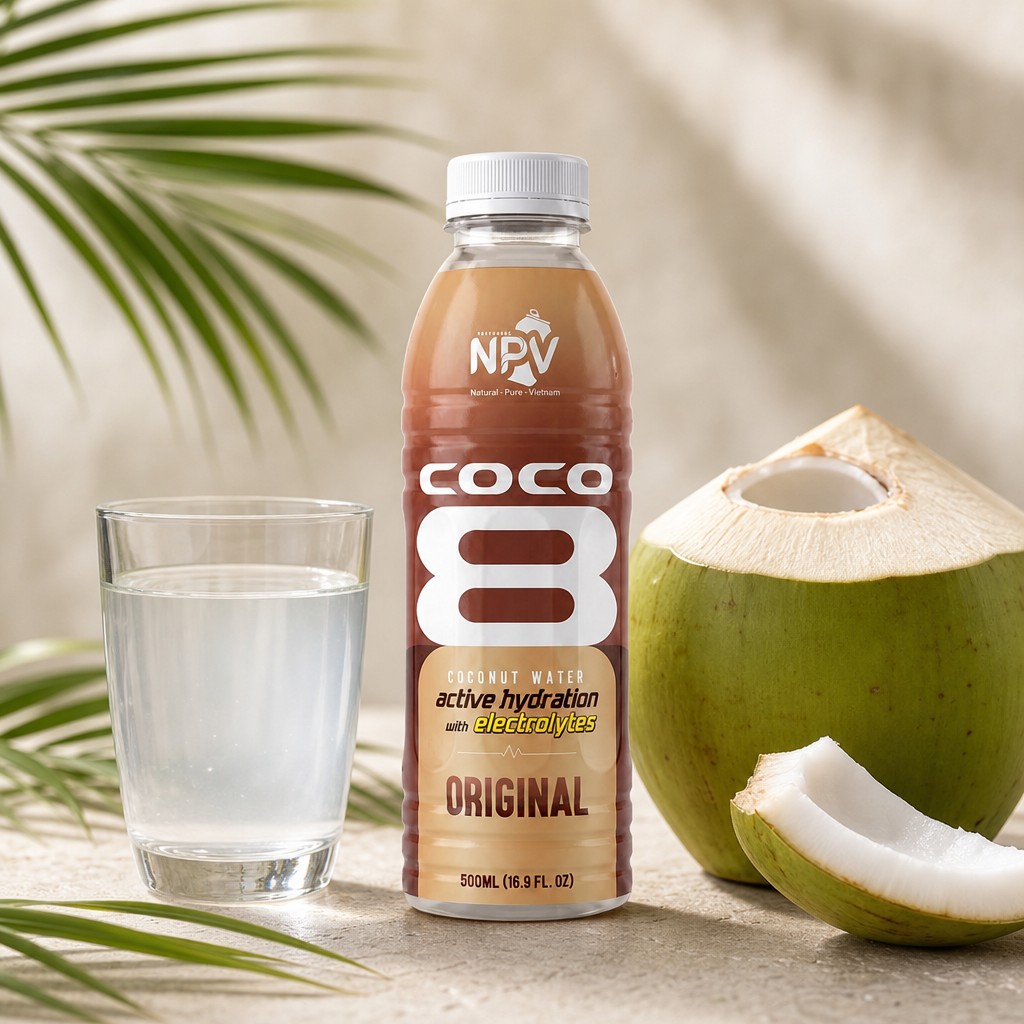
The 500ml PET bottle occupies a sweet spot in the hydration category. It is substantial enough to satisfy thirst during physical activity or travel, yet compact enough for single-handed carrying. The resealable cap is a practical differentiator against carton formats, allowing consumers to sip intermittently throughout the day without spillage concerns. For retail buyers, PET also offers advantages in terms of shelf durability, recyclability messaging, and transport efficiency compared to heavier glass alternatives.
This format consideration is not trivial. Category data consistently shows that consumption occasions drive volume, and a well-matched package size can unlock incremental turns at the shelf. Distributors serving gyms, convenience chains, and travel retail outlets have reported steady demand for resealable hydration formats, a trend that favors PET-based coconut water offerings.
From Our Orchards: Raw Material Sourcing and Farm Origins
The quality of a coconut water beverage begins long before it reaches the bottling stage.
NPV Beverage’s sourcing strategy draws on partnerships with local Vietnamese farms, where coconut cultivation benefits from favorable tropical growing conditions and established agricultural expertise. Traceability from field to bottle is a growing procurement requirement among international buyers, and direct farm relationships help ensure consistency in raw material quality across production cycles.
The company’s sourcing footprint is anchored in the Mekong Delta region, an area widely recognized for its high-quality raw ingredients used in premium beverage production. The Mekong Delta raw ingredients area provides a reliable foundation for fruit-based beverage manufacturing, with established supply chains connecting growers to processors.
For coconut specifically, dedicated growing regions supply the fresh nuts that are processed into the coconut water used in products like COCO 8. The Ben Tre coconut farm journey from plantation to finished goods illustrates how Vietnamese coconut supply chains operate, from harvesting through to the quality controls that govern export-grade output.
For buyers conducting due diligence on raw material provenance, these farm-level narratives provide useful context. Understanding where coconuts originate, how they are harvested, and the standards applied during initial processing helps importers build confidence in the consistency of the final product they receive.
Export Capabilities and Certification Credentials
Certification coverage and export reach are the twin pillars of any credible B2B beverage supplier.
NPV Beverage, formally Nguyen Pham Viet Beverage Co., Ltd., was established in 2019 and has built a compliance portfolio that spans the requirements of most major importing jurisdictions. The company holds BRC and FSSC 22000 certifications alongside ISO, GMP, and HACCP credentials, covering food safety management systems that European and North American buyers routinely demand. Halal certifications from both Jakim and HCA-GCC open doors across Middle Eastern and Southeast Asian Muslim-majority markets, while Kosher certification serves retailers and distributors operating in markets where that standard is expected.
The breadth of this certification stack matters practically. A supplier that can present BRC, FSSC 22000, Halal, Kosher, ISO, GMP, HACCP, and SMETA documentation in a single audit package significantly reduces the onboarding friction that importers face when qualifying new vendors. It also positions private label partners to move faster from concept to shelf across multiple territories without needing separate certification pathways per market.
Global Reach Across 200+ Export Markets
Export scale is another dimension where NPV Beverage differentiates itself from smaller regional suppliers.
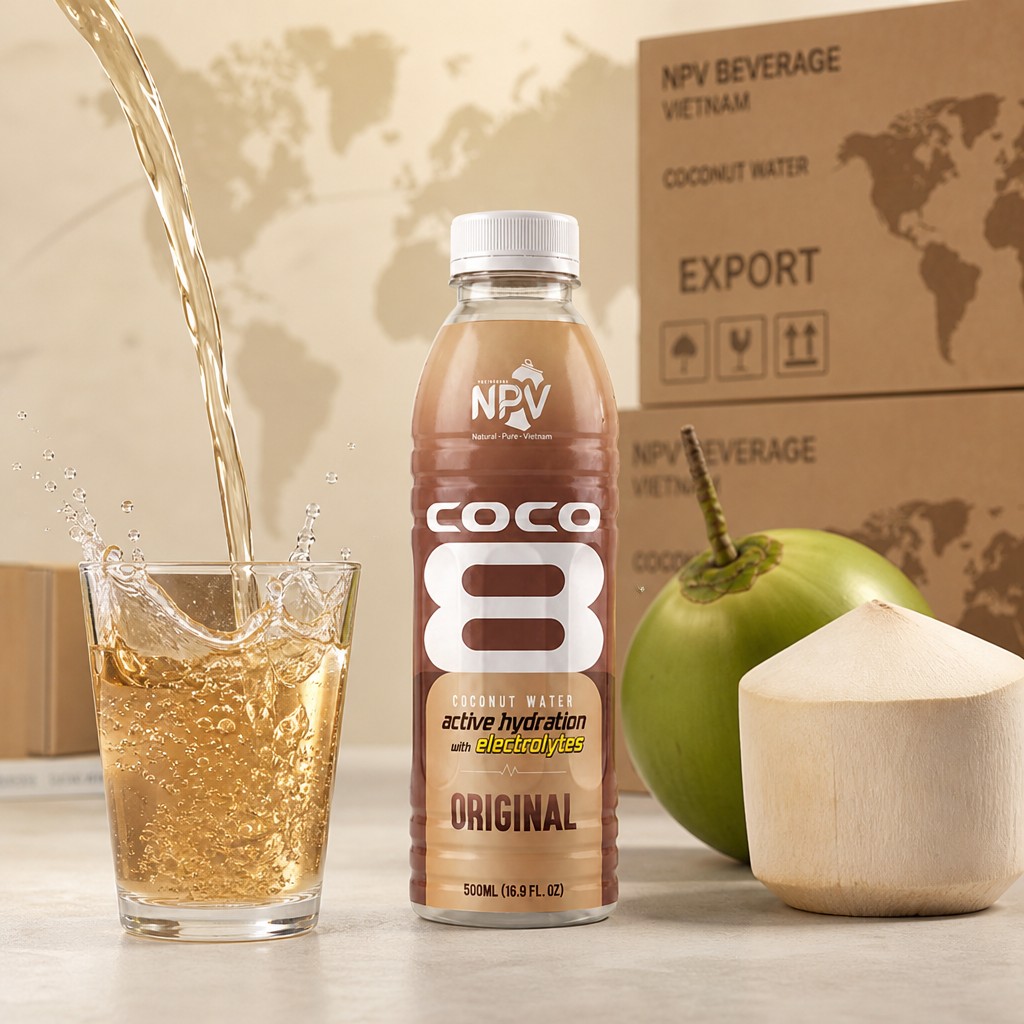
The company reports exports to over 200 countries and territories, a footprint that spans Asia, Europe, the Americas, the Middle East, Africa, and Oceania. This geographic breadth is significant for distributors evaluating supplier reliability. A manufacturer routinely shipping to diverse regulatory environments has, by necessity, developed logistics competence, documentation discipline, and product adaptation capabilities that newer entrants may lack.
For the coconut water electrolyte category specifically, this global reach means COCO 8 has been positioned to serve varied consumption cultures, from sports nutrition channels in Western markets to everyday refreshment occasions in tropical regions. Buyers in the Americas assessing NPV’s coconut water product range will find a portfolio built for cross-border distribution rather than single-market limitations.
OEM and Private Label Opportunities for Coconut Water
The private label channel represents one of the most active growth vectors in beverages today.
Retailers and brand owners are increasingly turning to OEM and ODM partners to develop exclusive coconut water lines that differentiate their shelves without the overhead of in-house development. NPV Beverage’s service model is structured around this demand, offering customization across packaging formats, label design, and flavor profiles.
The company’s OEM capabilities are complemented by broader industry infrastructure. RITA, a Vietnamese beverage manufacturer with deep OEM and export experience, operates a comprehensive OEM service program that illustrates the depth of contract manufacturing expertise available in Vietnam’s beverage sector. For buyers comparing regional sourcing options, this ecosystem of established OEM providers offers both competitive pricing and proven quality systems.
COCO 8’s base formulation is particularly well-suited to private label adaptation. The clean coconut water profile serves as a versatile canvas for brands wishing to introduce flavored variants, limited editions, or region-specific packaging while retaining the core ingredient simplicity that drives consumer trust.
Customization Levers Available to Brand Partners
Practical customization options extend well beyond label artwork.
Brand partners can typically explore variations in bottle shape, cap color, label substrate, case configuration, and palletization to align with their distribution requirements. Flavor extensions, where pursued, can be developed through structured R&D processes that maintain the product’s clean-label positioning. Minimum order quantities and lead times are negotiated per program, giving buyers flexibility to test market response before committing to full-scale rollout.
For retailers evaluating a coconut water private label launch, the combination of an established base product like COCO 8 and an experienced OEM partner compresses time-to-market considerably compared to greenfield development.
Market Outlook for Coconut Water Electrolyte Drinks
The convergence of sugar regulation, clean label demand, and active lifestyle consumption patterns creates a favorable medium-term outlook for coconut water beverages.
Industry analysts point to several reinforcing dynamics. First, sugar taxes in markets like the proposed German framework tend to accelerate reformulation activity, pushing formulators toward naturally sourced bases. Second, the sports and outdoor recreation segment continues to expand globally, sustaining demand for convenient hydration formats. Third, the travel and convenience retail channel, a traditional stronghold for coconut water, is recovering strongly post-pandemic.
Table 1 summarizes the positioning of coconut water electrolyte drinks relative to common beverage alternatives across the dimensions that matter most to buyers.
| Attribute | Coconut Water (COCO 8) | Conventional Soft Drink | Sports Drink (Colored) |
|---|---|---|---|
| Primary Ingredient | Natural coconut water | Water, sugar syrup | Water, sugars, dyes |
| Artificial Colors | None | Common | Common |
| Preservatives | None | Common | Common |
| Sugar Tax Exposure | Low | High | Moderate to High |
| Pack Format | 500ml resealable PET | Can / PET | PET / Can |
| Clean Label Appeal | Strong | Limited | Moderate |
Table 1. Comparative positioning of coconut water electrolyte drinks versus common beverage alternatives.
These attributes explain why category buyers are increasingly flagging coconut water as a strategic hedge against sugar-related fiscal risk. The product category carries lower reformulation exposure, aligns with prevailing label-transparency trends, and fits naturally into the active consumption occasions that drive repeat purchase.
For brands considering entry or expansion in this space, the NPV 500ml Original Coconut Water Electrolyte Drink offers a commercially validated starting point, backed by a supplier with documented export experience and multi-standard certification coverage.
Frequently Asked Questions
What makes NPV COCO 8 suitable for markets with sugar taxes?
NPV COCO 8 is formulated from natural coconut water with no added artificial colors or preservatives, giving it a low sugar-tax exposure profile compared to conventional sweetened soft drinks. Its clean ingredient deck aligns with reformulation trends triggered by fiscal measures such as Germany’s reported sugar tax plan.
Which certifications does NPV Beverage hold for export?
NPV Beverage maintains BRC, FSSC 22000, Halal Jakim, Halal HCA-GCC, Kosher, ISO, GMP, HACCP, and SMETA certifications. This coverage supports distribution across Europe, the Middle East, North America, and other regulated import markets.
Can COCO 8 be customized for private label programs?
Yes. NPV Beverage offers OEM and ODM services that allow brand partners to customize packaging, labeling, and flavor profiles while retaining the core coconut water formulation. The company’s R&D and production capabilities support both small test runs and scaled commercial programs.
What packaging format does the product use?
The drink is packaged in a 500ml resealable PET bottle, a format favored for on-the-go consumption in retail, foodservice, and travel channels. PET offers advantages in shelf durability, transport efficiency, and recyclability messaging.
How extensive is NPV Beverage’s export network?
NPV Beverage reports exports to more than 200 countries and territories, spanning Asia, Europe, the Americas, the Middle East, Africa, and Oceania. This reach reflects established logistics and compliance capabilities across diverse regulatory environments.