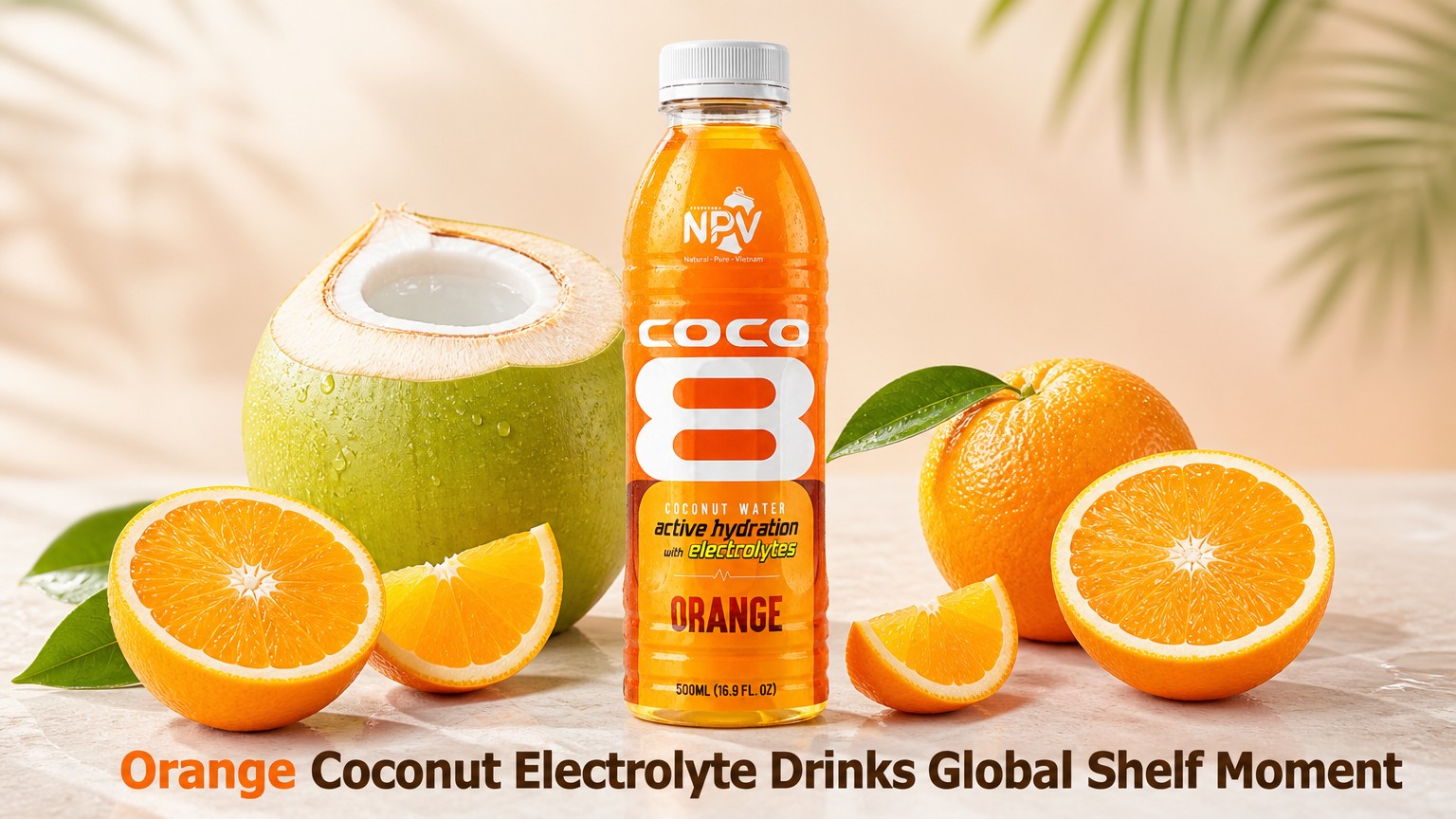
Coconut-based beverages continue to attract attention from international buyers, and the NPV 500ml Orange Coconut Water Electrolyte Drink shows how Vietnamese manufacturers are responding to that interest. Produced by Nguyen Pham Viet Beverage Co., Ltd., known as NPV Beverage, the product pairs natural coconut water with a bright orange flavor note, added electrolytes and a portable 500ml PET bottle built for everyday carry. Across Asia, Europe, the Americas, the Middle East, Africa and Oceania, importers and retail groups are searching for single-serve formats that sit comfortably between juice, coconut water and electrolyte-positioned refreshment. This article examines the format, the sourcing background, the private label opportunity and the wider industry signals shaping demand in the current cycle.
Key Takeaways
- The orange coconut water electrolyte drink combines natural coconut water, orange flavor and added electrolytes in a 500ml (16.9 fl. oz) PET bottle.
- Portability, resealability and mid-range volume make the format suitable for convenience, travel retail and chilled supermarket placement.
- Coconut groves and citrus orchards in Vietnam supply the base ingredients, supporting traceable sourcing conversations with buyers.
- The product is available for OEM, ODM and private label programs, giving distributors scope for branding and flavor adaptation.
- NPV Beverage holds internationally recognized food safety certifications and reports exports to more than 200 countries and territories.
Orange Coconut Water Electrolyte Drinks Move Toward the Global Mainstream
Single-serve bottles have become a default format for beverage shoppers worldwide. What once counted as a convenience upgrade is now a baseline expectation across most retail channels.
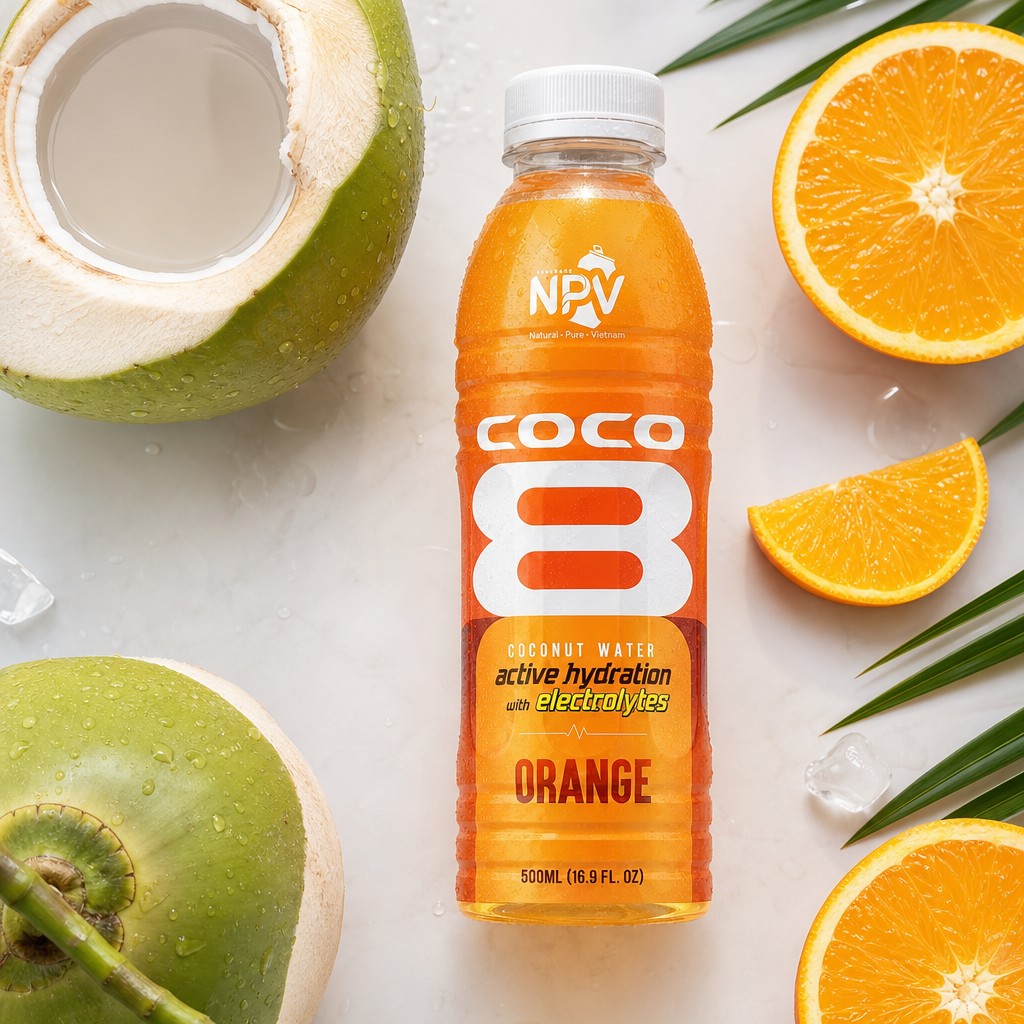
The orange coconut water electrolyte drink category sits at the intersection of three established shopper habits, namely coconut water consumption, citrus-flavored refreshment and electrolyte-positioned drinks purchased around sport, travel and warm-weather occasions. NPV Beverage interprets that intersection with natural coconut water as the base, orange flavor as the taste signature and added electrolytes as the positioning cue carried on the label. The result is a bottle that reads quickly in a chilled cabinet: a bright orange label, a clean white closure, clearly stated volume, and a short descriptor communicating active hydration with electrolytes at a glance.
Volume is part of that calculation. The 500ml sizing, equivalent to 16.9 fl. oz, lands in the middle of the single-serve market, large enough for a commute or a training session and small enough for impulse purchase at the point of chill. That balance is one reason PET bottles of this size keep winning facings in convenience stores, travel retail and supermarket cold cabinets. Buyers evaluating the format are, in practice, evaluating how the bottle behaves in a shopper hand as much as what the label communicates.
Flavor Strategy Behind the Coconut and Orange Blend
Coconut water on its own carries a mild, slightly sweet profile that many consumers describe as neutral. That character makes it an effective base for blending, and citrus is one of the most commercially proven partners for it. The orange note adds brightness and an immediate flavor cue shoppers can identify before they taste, which matters in a category where purchase decisions are often made in a few seconds at the shelf.
For buyers running private label programs, the blend also offers room to move. Flavor adaptation through research and development teams is routine work in OEM beverage production, and a coconut-water base with citrus has historically been one of the easier profiles to adjust in sweetness, intensity and aroma without losing the underlying character of the coconut water.
Where Retail Buyers Place the Format
Distribution discussions for this type of bottle tend to converge on a short list of channels where portability and chilled service overlap.
- Convenience and forecourt stores, where single-serve chilled drinks drive a high share of basket value.
- Travel retail and transit outlets, where passengers look for familiar flavors in sealed, carry-on-friendly packaging.
- Supermarket chilled cabinets positioned next to juice and coconut water ranges.
- Fitness and leisure venues that stock bottles alongside water and electrolyte mixes.
- Hotel and on-trade listings seeking a premium-looking single-serve option.
Inside the 500ml PET Bottle Format
Packaging is a commercial decision before it is a design decision, and the PET format carries several practical arguments in international trade.
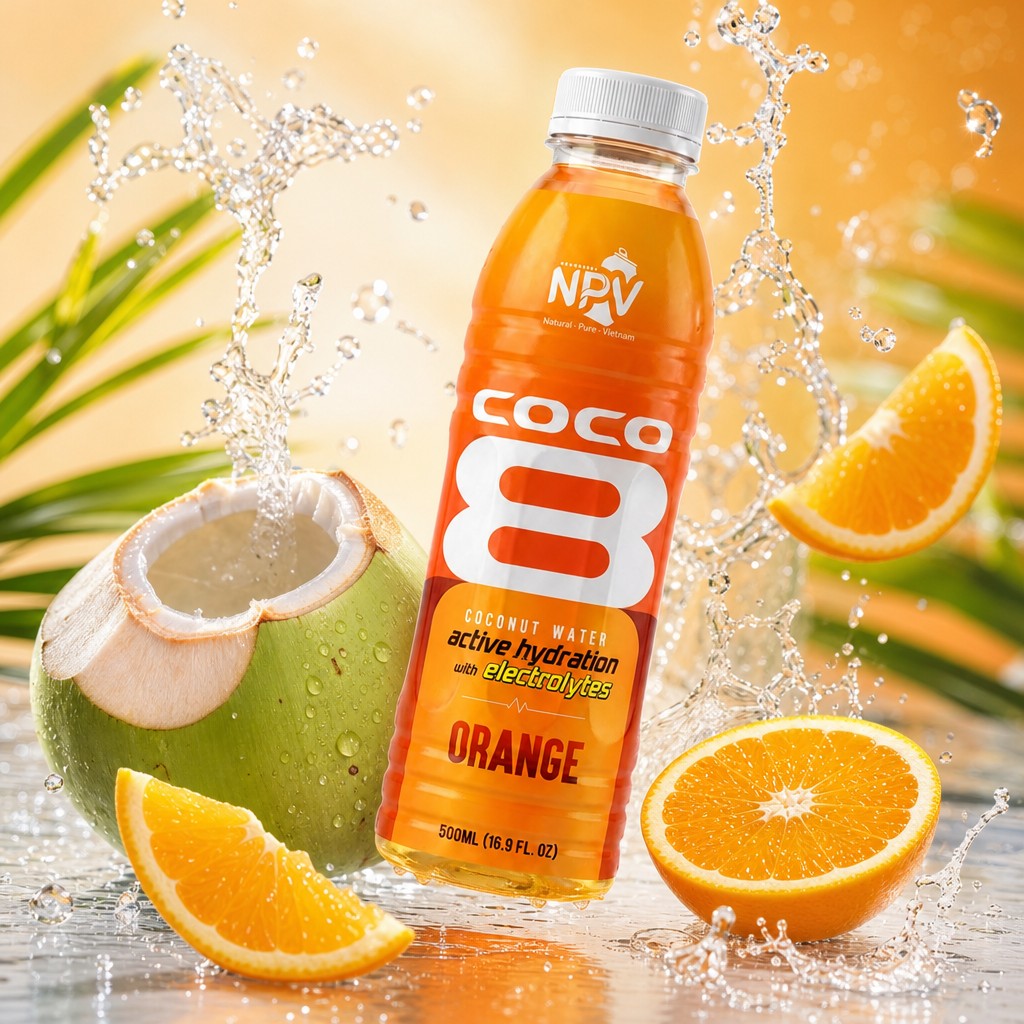
PET is lightweight relative to glass, which lowers freight cost per unit on long shipping routes and reduces breakage risk during handling. It is transparent, allowing the orange-toned liquid to act as its own visual cue, and it accepts full-body labels and sleeve decoration that give private label buyers a large canvas for branding. The screw closure makes the bottle resealable, a feature shoppers value when a drink is consumed across several hours rather than in one sitting. Chilling time is short compared with thicker packaging, which matters in hot-climate markets where a cold bottle sells at a premium moment.
The NPV 500ml Orange Coconut Water Electrolyte Drink is specified in a 500ml single-serve configuration with a clean, functional label layout. The ingredient declaration covers natural coconut water, orange flavor and electrolytes, giving buyers a short and legible list that fits most market labeling conventions. Volume is printed as 500ml with the 16.9 fl. oz equivalent, which supports dual-metric markets without additional artwork revisions.
| Attribute | 500ml PET bottle | 330ml aluminum can | 250ml pouch |
|---|---|---|---|
| Typical serving context | On-the-go and chilled cabinet | Immediate consumption | Lunchbox and children packs |
| Resealable | Yes, screw closure | No | Often, with zip or straw |
| Label canvas area | Large, wraparound possible | Full print, limited texture | Flexible but creases |
| Transparency of liquid | Visible | Not visible | Partially visible |
| Freight profile | Lightweight, stackable | Lightweight, dent risk | Lightest, shape variance |
Label, Artwork and Branding Flexibility
For a distributor building a private label range, the label area is the primary asset. The orange coconut water electrolyte drink presents its flavor name, volume and descriptor in a hierarchy that can be adapted without redesigning the structural elements of the bottle. NPV Beverage supports artwork revisions, language variants for multilingual markets and case configurations suited to local retail standards.
Print and decoration options extend to sleeve application and matte or gloss finishes, which let a buyer match the bottle to an existing portfolio. The company also runs flavor research and development for adaptation, so an importer that needs a different sweetness level or a stronger citrus lift can request a formulation review before production is locked.
These variables are documented on the product page for the NPV 500ml Orange Coconut Water Electrolyte Drink, where buyers can review volume, packaging and ingredient details alongside the wider coconut water catalog.
From Coconut Groves and Citrus Orchards
Sourcing transparency is increasingly part of buyer due diligence, and Vietnamese supply chains for both coconut and citrus have attracted documented attention.
Coconut water for beverages of this type is typically drawn from young fruit harvested in the Mekong Delta, where groves are managed for consistent sweetness and water yield. The Ben Tre coconut plantation report describes a plantation-to-processing journey that buyers can reference when evaluating the origin of coconut water raw material entering export supply: Ben Tre coconut farm from plantation to high-quality products.
On the citrus side, orange flavor work in the Vietnamese beverage industry is supported by orchard sourcing programs that track fruit quality from field through concentrate and flavoring stages. An orange orchard sourcing feature published by the sector gives a useful picture of how citrus raw material is selected and handled before it reaches a blending line.
Video footage of the coconut sourcing environment is also available for buyers who want a visual reference before requesting samples or arranging an audit visit.
Private Label and OEM Opportunities for Coconut Water and Citrus Blends
The strongest commercial angle for this bottle is not the single SKU itself but the manufacturing capacity sitting behind it.
NPV Beverage operates as a business-to-business manufacturer and exporter with OEM and ODM capability across a wide portfolio, and the broader group behind the brand, RITA, has built a comparable track record in private label beverage production for international buyers. That combination matters for distributors who need more than a stock product: it means formulation support, packaging flexibility and a supply chain that can be audited.
The coconut water product range available through the manufacturer covers plain coconut water, flavored variants and electrolyte-positioned blends, so a buyer can build a tiered offering rather than listing a single item. A fruit juice portfolio sits alongside it, covering familiar citrus and tropical profiles that often share shelf space with coconut water in retail layouts. Grouping these lines under one supplier simplifies logistics, documentation and quality management for importers managing several SKUs at once.
Customization Variables Open to Buyers
Private label programs typically open with a short specification discussion. The variables most often on the table include:
- Flavor intensity, sweetness level and aroma profile, adjusted through research and development trials.
- Label artwork, language versions and finish options including gloss or matte treatment.
- Bottle size, closure color and case configuration for local retail standards.
- Certification set required by the destination market, including Halal, Kosher and food safety schemes.
- Minimum order quantities and shipment scheduling aligned to the buyer seasonal calendar.
Buyers reviewing the full specification can open the NPV 500ml Orange Coconut Water Electrolyte Drink listing for volume, ingredient and packaging detail, then request a sample matched to their own market profile.
Industry Signals From the Global Beverage Market
Several recent developments across the beverage sector offer useful context for buyers evaluating new listings.
PepsiCo estimate of a lower payout bill related to Poppi suggests that large players continue to price in recalibrated expectations around fast-growing brands, a reminder that shelf momentum and financial performance do not always move together. For smaller exporters, that gap is an opening: retailers still refresh listings, but they do so with more scrutiny on margin and supply reliability.
Olvi share price drop after a profit warning points to cost pressure in established European markets, where input and energy costs are squeezing mid-size producers. Pressure of that kind tends to push buyers toward sourcing regions with more competitive cost structures, including Southeast Asia.
Nestle decision to earmark additional capital for Mexico shows that infrastructure investment remains focused on markets with population scale and rising packaged drink consumption. Kirin partnership with HiteJinro for beer production in South Korea illustrates how regional collaboration is being used to access capacity and distribution without building from scratch.
LVMH continued growth in wine and spirits indicates that premium positioning still works in beverage categories, provided the story behind the bottle is credible. Across these signals, one theme repeats: buyers reward suppliers who can pair a clear product narrative with dependable execution.
Positioning the Bottle Across Worldwide Markets
Market fit varies, and the same bottle can be positioned differently depending on the destination.
In warm-climate markets across Asia, the Middle East and Africa, the orange coconut water electrolyte drink is a natural fit for chilled impulse channels and travel retail. In Europe and the Americas, buyers more often position it alongside premium coconut water and juice ranges, where the electrolyte descriptor and citrus note differentiate it from unflavored alternatives. In Oceania, the portability argument carries weight in leisure and fitness settings. The common thread is the bottle itself: 500ml PET, resealable, clearly labeled.
Certification coverage supports those conversations. NPV Beverage production base holds BRC and FSSC 22000 food safety certification, Halal certification under both Jakim and HCA-GCC schemes, Kosher certification, and ISO, GMP, HACCP and SMETA audit coverage. That set is designed to satisfy import documentation across most destination markets, and the company reports exports reaching more than 200 countries and territories.
For a distributor weighing a new line, the practical next step is to review the orange coconut water electrolyte drink in PET bottle format, confirm certification requirements for the target market, and request a private label quotation with the artwork timeline attached.
Frequently Asked Questions
What is inside the NPV 500ml Orange Coconut Water Electrolyte Drink?
The formulation combines natural coconut water, orange flavor and added electrolytes, filled into a 500ml (16.9 fl. oz) PET bottle with a screw closure.
Is the product available for private label or OEM production?
Yes. The bottle is offered through private label, OEM and ODM programs, covering label artwork, language variants, flavor adjustment and case configuration for local retail standards.
Which certifications support export of this drink?
The manufacturing base holds BRC, FSSC 22000, Halal Jakim, Halal HCA-GCC, Kosher, ISO, GMP, HACCP and SMETA, covering food safety, religious dietary requirements and social compliance audits.
What is a typical ordering and shipping arrangement?
Buyers discuss minimum order quantities, container loading and shipment scheduling directly with the sales team, with production planned against the buyer seasonal calendar and destination port requirements.
Can the flavor profile be adapted for a specific market?
Flavor research and development is available for adjustment of sweetness, citrus intensity and aroma, usually confirmed through sample trials before production is locked.